Facebook
  • Surlon Power LFP | SLA Replacement batteries,12.8V20Ah
  • Surlon Power LFP | SLA Replacement batteries,12.8V20Ah

Surlon Power LFP | SLA Replacement batteries,12.8V20Ah

No.QSTD09
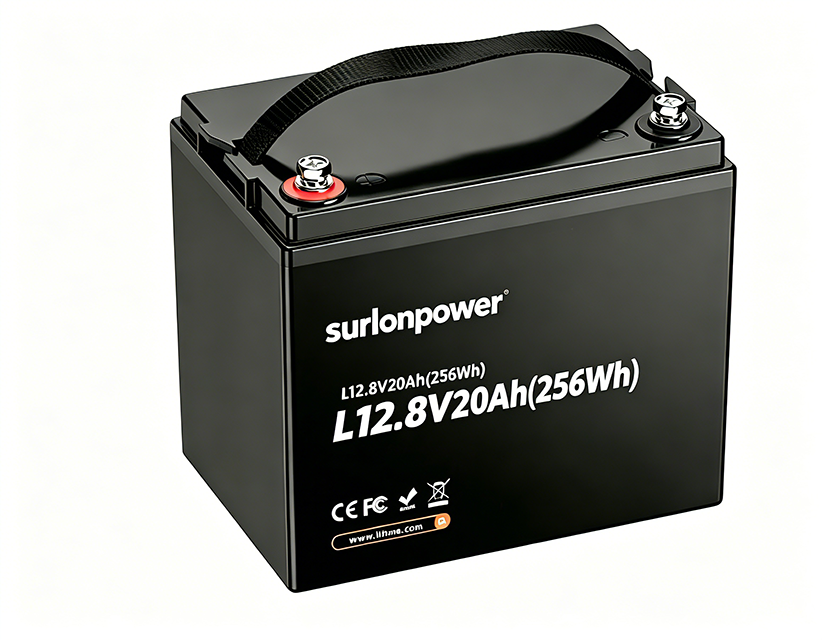
A 12.8V compact lead acid replacement for UPS, solar and backup cabinets: 20Ah LiFePO4, 256Wh, IP65 ABS case, over 2,000 cycles, no watering.
  • Surlon Power LFP | SLA Replacement batteries,12.8V20Ah

Description

Product Overview

The QSTD09 is a 12.8V 20Ah LiFePO4 battery pack that stores 256Wh in a 197 × 132 × 169 mm case. It fills the position and the duty of a 12V sealed lead-acid block while removing the routine that comes with one — no watering, no acid handling, no corroded terminals to scrub clean.

Inside the case, LiFePO4 cells sit under an integrated battery management system that handles protection and cell balancing. The pack is charged from a LiFePO4 profile and discharged like any other 12V block.

The work this model does is steady and mostly unattended. It keeps UPS and telecom cabinets alive between outages, buffers a small solar array overnight, holds up access control and alarm panels, runs emergency luminaires, and feeds portable power boxes and industrial control gear. Where a project needs a larger 12V bank, several units can be arranged together, provided the string is designed for it.

Case, terminal layout and internal configuration can also be adapted, which is why this model so often becomes the base for a custom SLA replacement battery: capacity, connector and communication interface are set around the equipment you are building rather than around a catalogue number.

Direct Replacement for SLA Batteries

  • Same 12V position. A 12.8V nominal pack is the lithium equivalent of a 12V lead-acid block, so inverters, controllers and DC loads recognise it without a voltage conversion. What changes is the shape of the discharge: the pack holds its voltage far longer and then falls away near the end, instead of sagging steadily through the shift.
  • Charger first. The pack needs a charge profile that reaches the charge voltage in the specification. A lead-acid charger set to a float-only regime will leave it partly charged, and an equalise or desulphation cycle has no place here. Check the charger model with us before the first charge.
  • Footprint and clearance. Compare the case drawing against the tray or cabinet you are filling and leave room for cable bends, lugs and terminal covers. A pack that touches the cabinet lid is a pack you cannot inspect.
  • Series and parallel banks. 24V and 48V systems are usually built from 12V blocks in series. Send us the string layout and the way the bank is charged so the BMS arrangement and balancing approach can be confirmed for each unit.
  • Load cut-off. Set the inverter or controller low-voltage cut-off above the pack's discharge cut-off, so a BMS disconnect stays a protection event rather than the point at which every cycle ends.
  • What carries over. Cable lugs, fusing, isolation and inspection routines from the lead-acid installation still apply — the upgrade changes the chemistry, not the electrical safety practice around it.

Charging & Discharging Behaviour

Charging is ordinary CC/CV work: bring the pack to its charge voltage, hold it, and let the current taper as the cells fill. The BMS balances the cells in the background, so there is no equalise stage to schedule, no temperature compensation to set and no electrolyte to check. A charger with a LiFePO4 profile and a voltage window that matches the specification is the whole requirement.

Current planning is where most projects need a decision. The standard charge current is the figure to design a recharge window around; for this capacity it is roughly a one-hour rate. The maximum charge current exists for faster recovery when the charger, the cabling and the cell temperature can support it. On the discharge side, the continuous rating suits steady 12V loads — routers, controllers, LED drivers, small inverters — while the pulse rating covers switch-on inrush from motors and inverters. That pulse figure is a short-duration allowance, not an operating point: tell us the duration and repetition your load actually produces and we will confirm whether the pack is the right size.

Temperature sets the working boundary. Charging is specified from 0 °C to 45 °C and discharging from -20 °C to 60 °C, so a pack in a cold plant room needs to be inside the charge window before a cycle starts, and one in a hot cabinet should be checked against the upper limit during the hottest part of the day. A temperature trip in either direction is a signal about the installation, not a fault in the pack.

Efficiency matters most in solar and remote work: nearly all the charge current reaches the cells and the discharge loss is small, so a modest pack keeps delivering usable energy through repeated shallow cycles instead of losing a slice at every conversion.

Cycle Life & Operating Economy

  • More than 2,000 full cycles. The rating is quoted at 100% depth of discharge under the standard charge and discharge procedure — the harshest way to count. In backup duty, where the pack discharges a handful of times a year, that count stretches a long way into the future.
  • Shallow cycling is gentler. A pack that runs a third of the way down and comes back up does not take the same wear per event as one that empties completely; solar buffering and UPS duty both tend to sit in that shallow band.
  • Heat is the real variable. Capacity fades faster in a hot cabinet than in a cool one, whatever the cycle count says on paper. Ventilation, spacing from heat sources and shade on outdoor enclosures do more for service life than any setting on the charger.
  • Replacement frequency is the cost line. A lead-acid block in the same duty is replaced several times over the life of one lithium pack, and every swap carries labour, downtime and disposal. That arithmetic, not the unit price, is where the payback sits.
  • Storage 0 °C to 40 °C. Store the pack part-charged rather than flat, keep it inside that window, and recharge it before it goes back into service after a long idle period.
  • End of life is gradual. The pack does not fail suddenly; usable capacity fades until runtime no longer meets the duty. Plan replacement on runtime measurements rather than a calendar date, and route the old pack to a battery collection or recycling service rather than general waste.

BMS Protection & Safety

The integrated battery management system watches voltage, current and temperature at cell level and intervenes before any of them leaves the safe window. Over-charge protection stops the charge when a cell reaches its limit. Over-discharge protection disconnects the load before the cells are run flat. Over-current and short-circuit protection catch wiring faults and stalled loads. Temperature protection holds the pack back outside its charge or discharge range. Cell balancing runs alongside all of it, keeping the series cells aligned so usable capacity does not shrink around the weakest cell.

The chemistry underneath is lithium iron phosphate. Its olivine cathode is far more tolerant of abuse than cobalt-based lithium chemistries, and it does not behave like a lead-acid cell on overcharge — which is why LiFePO4 is the default choice for cabinets, vehicles and equipment that sit unattended.

Protection is a backstop, not a control strategy. Fuse the output, keep polarity right, use cables sized for the continuous current, and mount the pack where a dropped tool or a metal panel cover cannot short the terminals. If the BMS trips, find out why before resetting it — repeated trips are the pack telling you the load or the charger is outside its specification.

Build, Weight & IP65 Enclosure

  • 4.39 kg. One person can lift the pack into a tray, which changes how a swap is planned in a rack or a cabinet — no lifting equipment, no acid spill kit, no two-person job.
  • Moulded ABS case. The body resists knocks and vibration, insulates the cells from the metal around them and keeps its shape over years in service. It will not corrode, and it will not stain the cabinet the way a weeping lead-acid block does.
  • IP65 protection. The rating means dust cannot enter and water jets from any direction will not get inside. That covers indoor plant rooms, washdown areas and sheltered outdoor enclosures; it does not mean the pack can be submerged.
  • M6 terminals. M6 studs take standard ring lugs, so the existing cabling hardware carries over. Torque them to the figure on the specification sheet and re-check after the first week of service.
  • No gas, no acid, no corrosion. A sealed lead-acid block gases during charge and leaves acid deposits on terminals and trays. This pack does neither, which is why cabinets stay clean and terminal maintenance drops off the schedule.
  • Sized for existing cabinets. It is chosen as a 12.8V compact lead acid replacement for trays cut for a 12V block, where a larger lithium case would mean rebuilding the enclosure rather than reusing it.

Monitoring & Communication Options

Where the equipment needs to know what the battery is doing, the pack can be built with a communication interface. SMBus, RS485 and RS232 are the options. Each is specified per project rather than fitted as standard, because the protocol, the connector and the way the host reads the data all depend on the device at the other end.

An LED state-of-charge indicator is the simpler alternative. It shows the operator at a glance how much capacity is left, which is often all an installer or a service technician needs, and it avoids adding another protocol to the system.

Both are set at configuration stage. Tell us which interface you want, what it connects to, and what the host needs to read — pack voltage, current, state of charge, temperature or protection status — and we will confirm what the selected BMS can report and how the wiring should be pinned. If the host runs its own protocol, say so early: matching an interface during configuration is far simpler than adapting a finished pack.

Applications

  • UPS and telecom cabinets. The pack holds the 12V rail through short outages and generator changeover; its steady voltage means the inverter sees fewer brown-out conditions than it would with a sagging lead-acid block.
  • Small solar and off-grid storage. The energy in this pack suits lighting, sensors, routers and instrumentation on a remote site, where shallow daily cycling and a charge controller set to a LiFePO4 profile are the normal pattern.
  • Emergency lighting and exit signage. Sealed, maintenance-free and dust-tight, the pack sits in a ceiling void or corridor cabinet without the ventilation a lead-acid block would need.
  • Security, access control and alarm panels. These draw tiny continuous currents and need a battery that still takes charge after months on float; low self-discharge and BMS management suit that pattern.
  • Marine and RV auxiliary circuits. House lighting, pumps and instrument feeds on 12V systems, in a case that will not spill acid when the vessel heels or the vehicle hits a pothole.
  • Mobility and light electric vehicles. Small 12V traction and auxiliary duties where the weight saving counts and the duty is short and repeated.
  • Portable power boxes and mobile workstations. A sealed case with no liquid inside keeps a hand-carried unit manageable and safe to store indoors.
  • Industrial control and instrumentation. PLC backup, remote telemetry and sensor nodes in sealed cabinets where access for maintenance is rare.

Specifications

ItemSpecification
ModelQSTD09
Battery chemistryLiFePO₄
Nominal voltage12.8V
Nominal capacity20Ah
Energy capacity256Wh
Cycle life>2000 cycles @ 100% DoD
Internal resistance≤40mΩ
Standard charge voltage14.4 ± 0.2V
Charge current (standard / maximum)20A / 30A
Discharge current (continuous / maximum pulse)20A / 80A
Discharge cut-off voltage10.8V
Charge / discharge efficiency100% at 0.3C / 96–99% at 0.3C
Charging / discharging temperature0 °C to 45 °C / -20 °C to 60 °C
IP rating / case materialIP65 / ABS

Custom Configuration & Ordering

  1. Send the brief: the equipment, its voltage window, continuous and peak load, available compartment space, the terminal or connector you need, whether you want a communication interface, and the volumes you are planning.
  2. We check it against this platform. If the standard 12.8V 20Ah LiFePO4 battery pack already suits the device, that is the shortest route; if it does not, the same cells and BMS platform are rebuilt as a custom SLA replacement battery with the capacity, case, terminals and interface your product needs.
  3. Review the proposal: configuration, drawing, protection thresholds, interface and the specification revision that will apply to your order.
  4. Build and validate a sample against your own device and charger — fit, runtime, charging behaviour and interface — and record the results before approving production.
  5. Approve the revision, then move to production with the documents that travel with the shipment.
  6. Confirm the commercial side with your sales contact: order quantity, lead time, packing, shipping terms and the documentation your destination market requires. These are quoted per project rather than published as fixed terms.
  7. Keep the specification revision on file. Repeat orders are built to the revision you approved, and any change to the device comes back through step one.

Series & Parallel Bank Configuration

  • One block, several system voltages. A 24V string is two of these 12.8V blocks in series and a 48V string is four, so the same 12.8V 20Ah LiFePO4 battery pack serves 12V, 24V and 48V projects without a separate pack design for each. What is decided per project is the string layout, the charger setting and how the bank is monitored.
  • Charge voltage follows the string. Each block expects 14.4 ± 0.2V across its terminals, so a two-block string is charged at 28.8V and a four-block string at 57.6V, with the cut-off scaling the same way from 10.8V per block. Set the charger for the string it feeds rather than for a single block, and send us the charger model before the first charge.
  • Balancing stops at the case. The BMS balances cells inside one pack; it cannot balance one pack against another. Build a series string from units of the same model and revision brought to the same state of charge, and when two strings are paralleled, match them to the same voltage before closing the link and keep cable lengths equal so the current splits evenly.
  • A trip takes the string down. Each block protects itself against over-charge, over-discharge, over-current, short circuit and temperature, and a disconnect in one unit interrupts the whole series string. Treat that as a protection event, not a normal end of cycle, and find the cause before resetting it.
  • Watch each block. The optional SMBus, RS485 or RS232 interface, or the LED state-of-charge indicator, is what shows an operator one block drifting away from the rest of the bank. In a multi-unit installation that visibility is worth specifying, because without it divergence only appears as a shorter runtime.
  • Do not tap a string for 12V. Pulling 12V loads from one block in a 24V or 48V string unbalances it against its neighbours. Feed 12V equipment through a DC-DC converter and keep the string symmetrical.
  • Cables, fusing and isolation. Inter-unit links sit at full string voltage and carry the continuous current — 20A per block — so size them accordingly, fuse the string and provide a means to isolate the bank for service. Torque the M6 terminals to the figure on the specification sheet and re-check after the first week of operation.
  • When a single pack is the cleaner answer. If the equipment is designed around one 24V, 36V or 48V block, we build those classes on the same LiFePO4 platform, with one BMS governing the whole battery instead of several units in series. Send the system voltage, load profile and compartment space and we will say which route fits better.

Monitoring & Communications

Optional communication functions are available for integration with monitoring and control equipment, covering SMBus, RS485 and RS232, and an optional LED state-of-charge indicator lets operators read battery status at a glance without connecting a laptop. Whether these options are fitted to a given unit, and how each battery is addressed once several are linked together, should be confirmed with the supplier when the order is placed.

Page Title

12.8V 20Ah LiFePO₄ Battery for UPS, Solar and Backup Power | Surlon Power

Meta Description

Surlon Power 12.8V 20Ah LiFePO₄ SLA replacement battery offers 256Wh energy capacity, 2000+ cycles, IP65 protection, fast charging, and maintenance-free performance for UPS, solar, and backup power applications.

Technical Support & Model Matching

Technical questions reach the people who build the packs. Our engineering group in Shenzhen reviews your device's voltage window, load profile, enclosure space and charger before proposing a configuration; our sample group then builds units so you can validate fit and runtime before production. Cell selection, BMS design and pack assembly stay in-house, with quality checks in process and at final inspection, and a documentation team handling certificates, test reports and shipping papers. When a unit behaves unexpectedly in the field, our engineers help trace the fault and advise on installation and commissioning.

FAQ

Can this battery replace a traditional SLA battery?

Yes, in the 12V position — a 12.8V LiFePO4 pack is the lithium equivalent of a 12V sealed lead-acid block, and it is often picked as a 12.8V compact lead acid replacement where cabinet space is tight. Two things decide whether a particular installation works: the charger must have a LiFePO4 profile that reaches the charge voltage in the specification, and the compartment, cabling and terminal hardware must suit the case. Send us the old battery's label, the charger model and a photo of the compartment, and we will tell you what needs to change before you order.

How long is the service life of this lithium battery?

The pack is rated for more than 2,000 cycles at 100% depth of discharge under the standard test procedure, and its design life is quoted at up to 10 years. Where a real installation lands between those figures depends on how hard it works: a UPS that discharges a few times a year will last far longer than one that empties daily, and a pack in a cool, ventilated cabinet will outlast an identical pack in a hot plant room. Depth of discharge, charge profile and ambient temperature are the three variables worth controlling.

Does the battery require maintenance?

Nothing routine in the lead-acid sense — no watering, no acid top-up, no corrosion to clean off the terminals. What it does ask for is sound installation practice: keep the terminals clean, dry and correctly torqued, keep the case clear of standing water, stay inside the charge and discharge temperature windows, and recharge after a deep discharge instead of leaving the pack flat for weeks. A visual check at each service visit is enough.

Can the battery be customized?

Yes. Capacity, case dimensions, terminal or connector type, communication interface and pack configuration can all be set for a project, and labels and packing can be discussed with your sales contact. A custom SLA replacement battery is normally built from the same cells and BMS platform: you send the device requirements, we propose the configuration, and a sample is built for validation before production. If the standard 12.8V 20Ah LiFePO4 battery pack suits your device, that is the faster route.

Is the battery safe?

LiFePO4 is the most thermally stable of the common lithium chemistries, and the pack adds an integrated BMS that cuts charge, discharge or output when voltage, current or temperature leaves the safe window. The sealed ABS case keeps dust and water out. The remaining risk sits in the installation, as it does with any battery: correct polarity, a fuse on the output, cables sized for the current, and a location where the terminals cannot be bridged by a tool or a panel cover. If the BMS trips, investigate before resetting it.

What happens if the battery is over-discharged?

The BMS disconnects the load before the cells are damaged, so the equipment simply stops instead of the pack being ruined. Recharge it as soon as practical afterwards — leaving a pack flat for weeks is what turns a recoverable event into permanent capacity loss. If the pack will not accept charge, check the charger profile and voltage window first; a lead-acid charger that never reaches the LiFePO4 charge voltage looks exactly like a failed battery.
Download

REQUEST A BATTERY QUOTE

Tell us about your equipment and battery requirements. Share the details you know, and our team can discuss the next steps for your project.
Name
Email *
Message
Leave a message
Name
Email *
Message
Message Us
