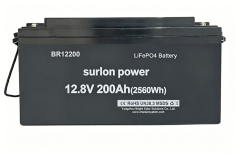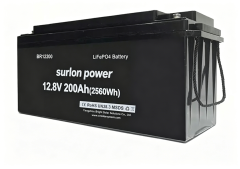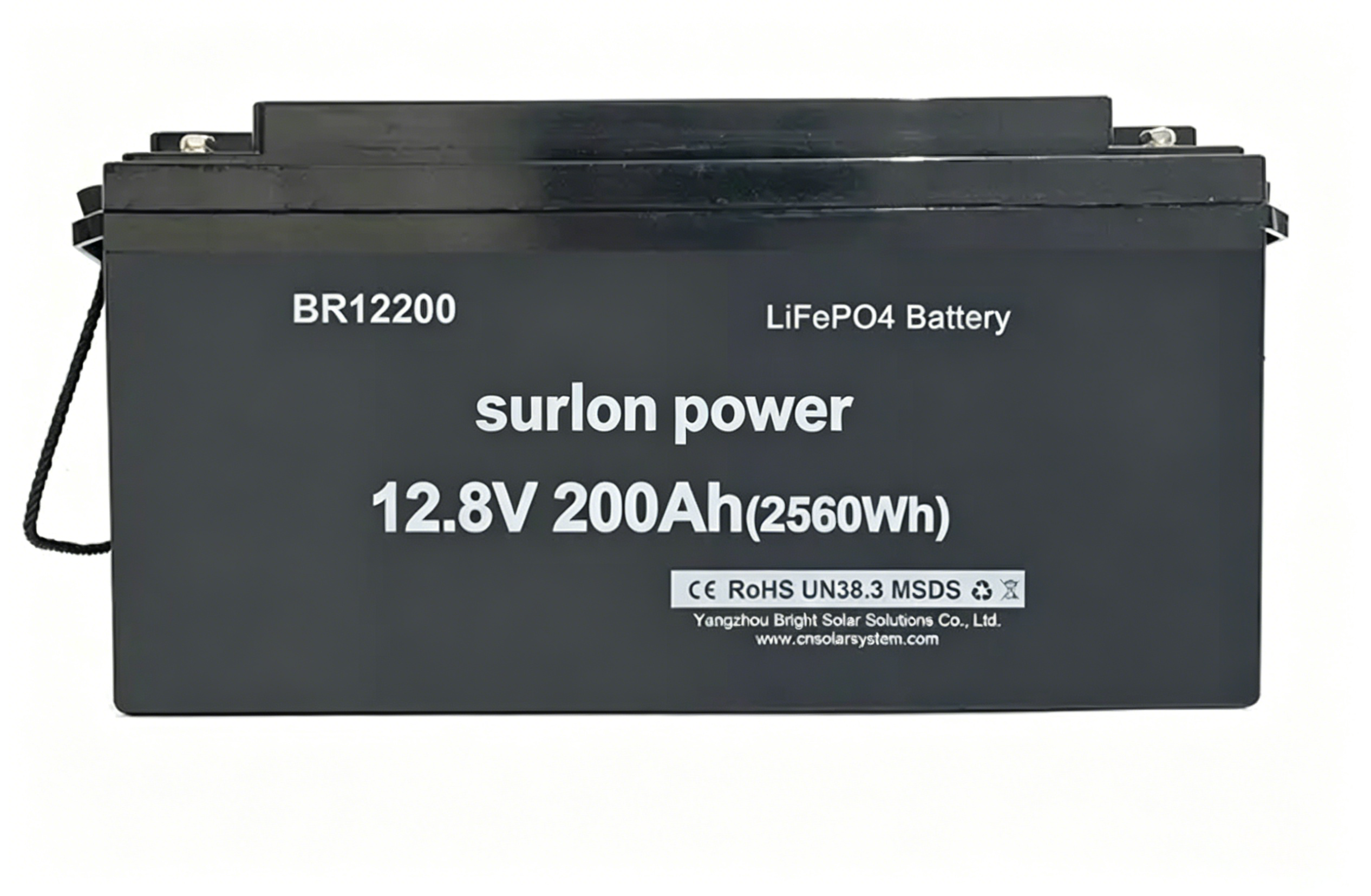
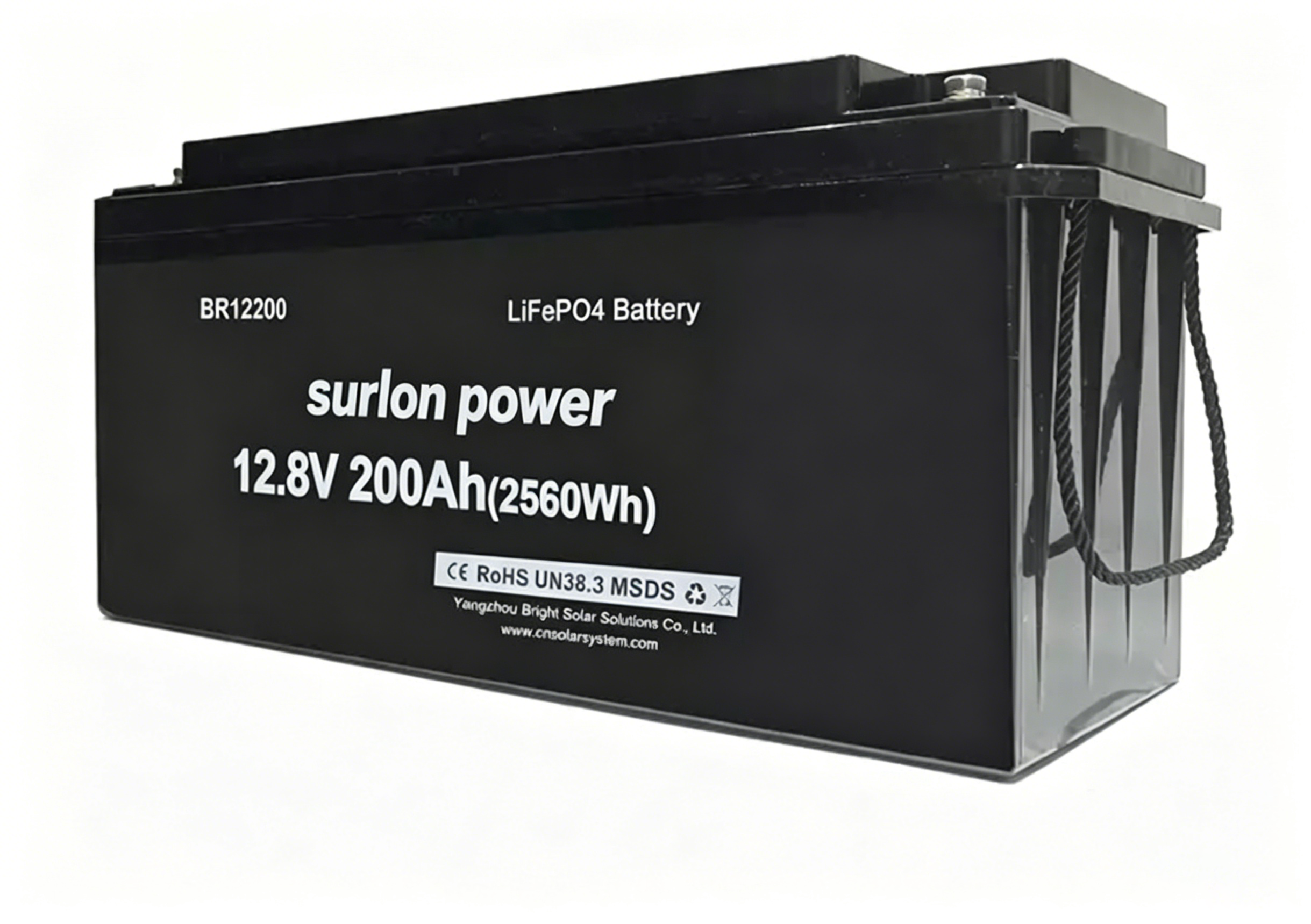
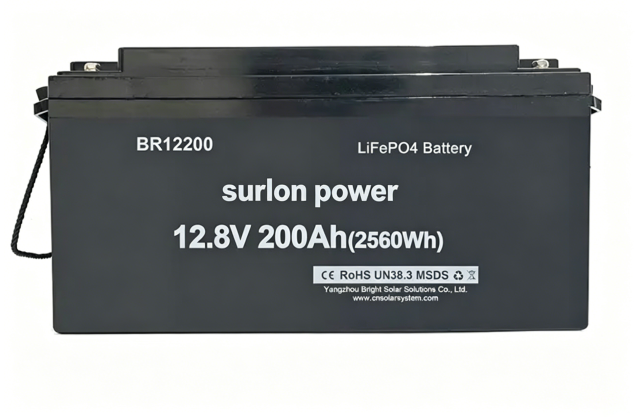
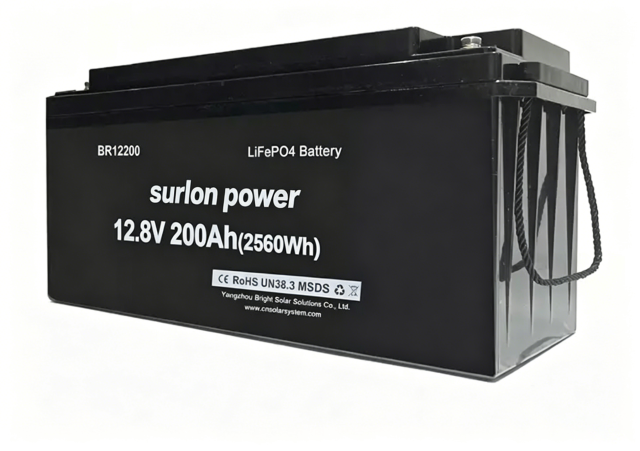

The GLFB5 is a 12.8V 200Ah LiFePO4 battery built as a single sealed block: 2560Wh of stored energy and an ABS case sized for a tray that previously carried a 200Ah lead-acid unit. Inside, lithium iron phosphate cells sit under an integrated battery management system that watches overcharge, over-discharge, over-temperature and short circuit, so the pack looks after itself between service visits. Surlon Power assembles it in Shenzhen for solar storage, RV and marine house banks, UPS and telecom standby, mobility vehicles and industrial deep-cycle equipment — duties that ask for hours of steady current followed by a recharge, not a cranking burst. M8 terminal posts and an IP65 enclosure mean the mechanical side of an installation is usually settled by the compartment dimensions rather than by the battery.
| Parameter | Value |
|---|---|
| Model | Product Model |
| Battery chemistry | LiFePO4 (LFP) |
| Nominal voltage | 12.8V |
| Nominal capacity | 200Ah |
| Stored energy | 2560Wh |
| AC internal resistance | ≤20 mΩ |
| Cycle life | >2,000 cycles @ 0.2C, 100% DOD |
| Continuous discharge current | 150A |
| Maximum pulse current | 200A ( |
| Case material | ABS |
| Dimensions (L × W × H) | 520 × 235 × 220 mm ±2 |
| Weight | 19.8 kg |
| Terminals | M8 |
| Ingress protection | IP65 |
| State of charge indicator | LED |
| Design life | Up to 10 years under the specified operating conditions |
A 200Ah block is normally specified where a pair of 100Ah units would otherwise be paralleled. Building the same capacity into one case removes a set of interlinks, one pair of terminals and one management system from the installation, which shortens the wiring and cuts the number of joints that can corrode. For a buyer treating this as a 12.8V battery for SLA replacement, the difference appears at commissioning: the pack drops onto the tray, two cables land on the M8 posts, and the charger is the only part of the system that needs rethinking. Current headroom is the other number to check. The 150A continuous rating works out at roughly 1.9kW at nominal voltage — enough for a 1.5kW inverter with margin, while a 2kW inverter sits just above it and has to be measured against the 200A pulse window instead.
| Parameter | Value |
|---|---|
| Charge voltage | 14.4 ± 0.2V |
| Charge cut-off voltage | 14.6V ± 0.2V |
| Standard charge current | 50A |
| Maximum charge current | 100A |
| Discharge cut-off voltage | 10V |
| Charge efficiency | 100% @ 0.3C |
| Discharge efficiency | 96–99% @ 0.3C |
| Charge temperature | 0°C to 45°C (32°F to 113°F) |
| Discharge temperature | -20°C to 60°C (-4°F to 140°F) |
| Storage temperature | 0°C to 40°C (32°F to 104°F) |
Packs are assembled in Shenzhen by a lithium battery manufacturer that keeps cell selection, BMS design and final assembly under one roof. That matters when a project needs a different case dimension, a connector change, a private label or a capacity variant: the request reaches the same engineering group that builds the standard GLFB5, and a unit can be built for validation before a production run. In-process checks and a final inspection sit between the cells and the shipping carton, and the documentation team prepares test summaries and transport papers for lithium shipments. Field questions — a charger that refuses to terminate, a protection trip that repeats — are traced by the engineers who designed the pack.
Technical questions reach the people who build the packs. Our engineering group in Shenzhen reviews your device's voltage window, load profile, enclosure space and charger before proposing a configuration; our sample group then builds units so you can validate fit and runtime before production. Cell selection, BMS design and pack assembly stay in-house, with quality checks in process and at final inspection, and a documentation team handling certificates, test reports and shipping papers. When a unit behaves unexpectedly in the field, our engineers help trace the fault and advise on installation and commissioning.
Only if that charger has a lithium mode you can select. The GLFB5 wants 14.4 ± 0.2V absorption and a 14.6 ± 0.2V cut-off, with equalisation and temperature compensation switched off; a flooded or AGM algorithm that equalises will push the pack outside its window. Many multi-chemistry chargers cover both profiles, so check the menu before the first charge.
The data table above lists the overall case dimensions, weight and terminal type. Check the tray footprint, the headroom above the posts for your lugs, and the hold-down arrangement against the drawing before the pack is lifted in, because a lithium case is restrained differently from a lead-acid block.
Engine starting and any submerged location. This is a deep-cycle pack built for hours of steady draw followed by a recharge, so a cranking load — outboard starting, generator starting, vehicle starting — belongs to a different battery. The IP65 case resists dust and water jets but is not sealed against immersion.
No. Charging is specified from 0 °C to 45 °C, while discharge runs from −20 °C to 60 °C. A pack stored or transported in sub-zero conditions should be allowed to reach 0 °C or above before the charger is connected, and the same applies to a solar array that starts producing before the compartment warms up.
The optional LED indicator gives a quick reading of remaining charge at the case, which saves carrying a meter to a remote site. It is a status aid rather than a coulomb counter, so log actual consumption with a shunt if you need precise runtime planning.
Yes, within the limits of the platform. Dimensions, connectors, labels, capacity and other application-specific requirements can be reviewed for qualified projects, and any change is agreed on the drawing before production. As a lithium battery manufacturer, the team that assembles the standard pack also handles the variant, so the conversation starts with your equipment: voltage window, load profile, compartment size and connector type.
One 12.8V 200Ah LiFePO4 battery carries 2560Wh, the same nominal energy as two 100Ah blocks in parallel, but with a single BMS, one pair of terminals and no interlinks between cases. Runtime still depends on the load: divide 2560Wh by your average draw in watts, then allow for inverter losses and the energy below your low-voltage cut-off.