Product Overview
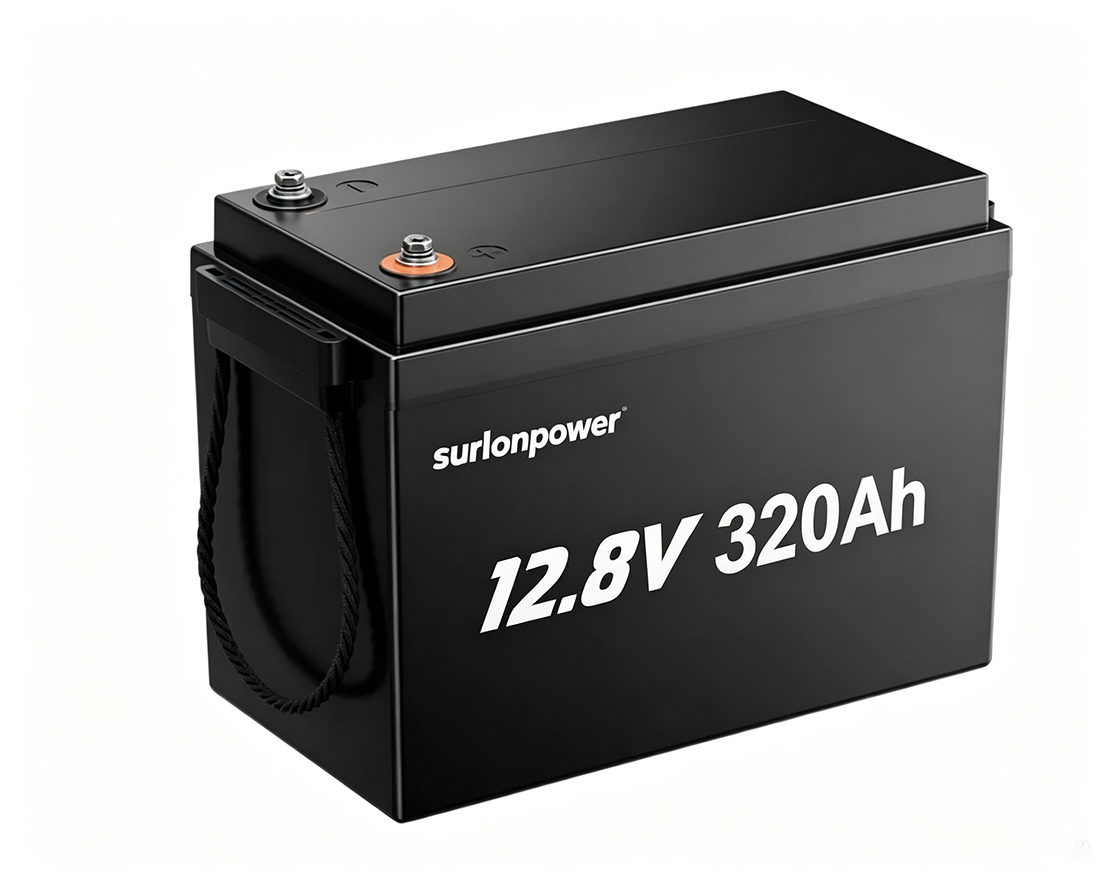
One case, one pair of terminals, 4,096Wh of stored energy. The QSTD10 puts a 320Ah LiFePO4 bank into a single 12.8V unit, so a van conversion, a pilothouse or a cabin no longer needs a row of lead-acid blocks joined by jumper links that loosen and corrode.
The 12.8V 320Ah LiFePO4 battery is built for house loads, not engine cranking: a compressor fridge, lights, fans, pumps, an inverter, a router, a camera that has to stay awake. On a boat it carries electronics and the control circuits around a windlass; off-grid it holds the day's solar harvest for the evening. Because the discharge curve is flat, terminal voltage stays steady as the bank empties, and an inverter sees a stable input instead of the slow slide of a tired AGM bank.
Day to day there is nothing to top up. No water, no terminal greasing ritual, no equalisation charge to schedule — and no need to guess at state of charge from a voltage reading taken at rest.
It is worth saying plainly what this unit is not. It is a deep-cycle storage battery; it is not a starter battery and should not be asked to crank an engine or absorb the inrush of a thruster motor directly. Size it for the loads that run for hours, and keep starting duties on a separate battery.
We build this pack for two kinds of buyer: the owner who wants one dependable bank instead of a maintenance routine, and the OEM or integrator who needs a repeatable 12V block with a specification sheet, a stable terminal layout and a supplier who answers technical questions. The same 12.8V family also includes a 100Ah pack for smaller banks, and matching BMS units are listed separately for system builders.
Technical Specifications
| Model | QSTD10 |
|---|
| Battery chemistry | LiFePO4 |
| Nominal voltage | 12.8V |
| Rated capacity | 320Ah |
| Nominal stored energy | 4,096Wh (4.096kWh) |
| BMS rating | 200A |
| Max continuous charge / discharge current | 200A / 200A |
| Maximum continuous output power | 2,560W |
| Charging method / charge voltage | CC/CV, 14.4V ± 0.2V |
| Recommended charge current | 64A |
| Bluetooth / self-heating | Included |
| Housing / protection rating | ABS / IP65 |
| Terminals | M8 × 16mm |
| Approximate weight | 57.3 lb |
Key Features
- Bluetooth monitoring you can read from the driver's seat. State of charge, pack voltage, current, charge or discharge status and protection alerts come through a compatible mobile app, so a bank buried under a bunk can be checked without lifting a lid. Confirm the app is supported on your phone and in your market before commissioning depends on it.
- Self-heating that earns its place in winter. An internal heater brings the cells up to a temperature where charging is permitted, which is what makes an unheated van, an outside locker or a winter mooring workable rather than a seasonal compromise. Heater activation and the charging conditions below freezing are set out in the product manual, and how long it takes depends on how cold the pack started.
- Low-temperature charge protection as a backstop. The BMS refuses charging below the permitted temperature whether or not the heater has finished its cycle. Do not bypass it, and do not let a charger with an override talk you into charging a frozen pack.
- A sealed case with handles, not a bare block. The ABS housing carries an IP65 rating against dust and water jets and has side handles so two people can lift it into a locker without improvising a strap. Treat the rating as protection against splashes and washdown, not permission to sit the pack in standing water.
- Chemistry that behaves like a battery should. LiFePO4 holds voltage flat under load and tolerates deep discharge without the sulking of lead-acid, and it needs no watering and gives off no acid mist — which matters when the pack shares a compartment with people, food or electronics.
- Support beyond the single unit. If this pack turns into a repeat build, our team can review terminal, cable and mounting details with you — the continuity a custom battery pack supplier should offer between the sample stage and series production.
Applications
Where a 12V bank has to carry a household's worth of small loads, this is the shape of battery that fits. In a camper or converted van it runs the compressor fridge, the water pump, LED lighting, a laptop and a router through the night, then takes the alternator or solar charge the next morning; one unit replaces the pair or quartet of blocks that used to live under the bench.
On a boat the same pack covers electronics, cabin lighting, a fridge and the control circuits for a windlass or thruster solenoid, in a compartment where acid spill and hydrogen gas used to be a design constraint. For off-grid cabins and sheds it stores the day's PV output for evening use, and because the voltage holds flat the inverter does not fade out at 30% state of charge the way it does on a tired lead-acid bank.
Backup and remote sites are the third natural home. Telecom huts, security cabinets, monitoring stations and small UPS-style installations need a pack that sits quietly on float, accepts a charge when the mains returns and can be checked remotely — Bluetooth means a technician does not have to open a cabinet in the rain to read a voltage.
For anyone replacing an existing bank, this is the moment to be precise. A 12.8V high capacity SLA replacement is a fair description of the job, but the charger, the cable and the terminal hardware have to be reviewed rather than assumed. A lead-acid charger with an equalisation or desulphation stage will not do; one that can be set to a LiFePO4 profile will. Where the old bank was a set of parallel blocks, the single case also removes a row of interconnects — one less thing to corrode.
None of these installations is a universal fit. Compartment height, cable entry direction, terminal clearance and airflow around the case all decide whether a given unit goes in without rework, which is why we ask for a photograph or a drawing of the space before quoting.
System Configuration & Installation
- Measure the space before anything else. The case is 14.49 × 7.44 × 10.04 in and needs clearance for the handles, the cable bend radius and the M8 studs on top. Leave a gap for air movement and check that the lid or hatch still closes over the terminals.
- Confirm the charger can run a LiFePO4 profile. If the unit is going into a boat, van or cabin that already has a charger, check that the equalisation and temperature-compensation stages can be switched off and that the absorption voltage can be set inside the range on the specification sheet. On a 12.8V high capacity SLA replacement job, the charger is often the smallest part of the work and the part most often overlooked.
- Size the DC path for the current you intend to draw. Cable, fuse or breaker, isolator and busbar all have to carry your continuous load with margin for surge — a 200A-capable battery is only 200A-capable if everything downstream of it is.
- Decide the bank layout before wiring. Parallel connection is the usual way to add capacity and it only works with matched units: same model, similar age, similar state of charge, equal cable lengths and a fuse per string. Series strings to reach a higher system voltage are a separate question — confirm the permitted configuration with us before you build one.
- Wire with the polarity and the torque in front of you. Isolate the system, connect the positive lead, then the negative, and torque the M8 hardware to the figure on the specification sheet rather than by feel. Check polarity twice at the inverter before the first switch-on.
- Commission with a real load. Charge the pack, open the app and record voltage, current and behaviour under your heaviest normal load, including the surge of a motor or compressor start. Send us that surge figure if you are unsure whether protection will hold; it is easier to review before installation than after.
Charging & Cold-Weather Operation
- Charge profile: CC/CV at 14.4V ± 0.2V. The 12.8V 320Ah LiFePO4 battery expects a lithium profile with a fixed absorption voltage and no equalisation stage. A charger that floats, pulses or desulphates on a lead-acid schedule is the wrong tool, even when the voltage window looks close.
- 64A is the recommended charge current. That gives a sensible recharge window for a 320Ah bank; a smaller charger is safe but slow, and a charger that pushes far more current needs its own review. Confirm the actual output of your charger rather than trusting the label on the box.
- Cold weather: heat first, then charge. When the pack is below its permitted charging temperature, the self-heating circuit runs until the cells are warm enough, and only then does charging begin. Budget for that wait on a winter morning instead of assuming the charger has failed.
- Heating time is not fixed. Starting temperature, insulation around the compartment and the way the pack is mounted all change how long the heater runs. A pack in a heated living space barely notices winter; one in an outside locker does.
- The BMS will refuse a cold charge. Low-temperature protection is a backstop and it does not care whether the heater has finished, whether the sun is out or whether the charger is set to an AGM profile. Let the pack warm up rather than overriding the protection.
- Charging and storage in practice. Bring the pack back to a partial charge before a long lay-up rather than leaving it flat, and follow the storage state of charge and recharge interval in the manual for your build — the right figure depends on the application and on how long the unit will sit.
Ordering & Delivery
- Describe the application, not just the voltage. Tell us what the pack powers — a camper house bank, a boat's electronics, an off-grid cabin, a monitoring cabinet — and the load list with the hours each item runs. Target runtime follows from that, not from a capacity table.
- Send the electrical envelope. Continuous current, the surge or start-up figure with its duration, inverter size, and the make and model of the charger you intend to use. If the job is a retrofit, say what is being replaced and what stays in place.
- Send the physical envelope. A photograph or drawing of the compartment, the cable route, the terminal hardware you already have and how the unit will be lifted in. A few centimetres of terminal access decide whether a case this size goes in without removing a shelf.
- Include the market and the volume. Destination country, any documentation your customer or customs broker will ask for, the quantity for the first order and the annual figure you expect. Packing, freight and delivery terms are confirmed with the quotation for your destination.
- Review the quotation properly. We reply with the proposed configuration, pricing and the warranty terms that apply to it, plus which documents are available for that exact build. Ask about sample availability and terms at the same time — a custom battery pack supplier should be able to tell you what a sample will and will not prove.
- Confirm the build sheet before production. Once the configuration is agreed, check the specification sheet against your own drawing: model, terminal, cable, BMS behaviour and labelling. Repeat orders run from that sheet, so it is worth reading twice.
Technical Support & Model Matching
Technical questions reach the people who build the packs. Our engineering group in Shenzhen reviews your device's voltage window, load profile, enclosure space and charger before proposing a configuration; our sample group then builds units so you can validate fit and runtime before production. Cell selection, BMS design and pack assembly stay in-house, with quality checks in process and at final inspection, and a documentation team handling certificates, test reports and shipping papers. When a unit behaves unexpectedly in the field, our engineers help trace the fault and advise on installation and commissioning.
FAQ
How long will a 12.8V 320Ah LiFePO4 battery run my loads?
Treat any figure as an estimate built from your own load list. Divide the usable energy by the average draw: a 4,096Wh pack serving a 200W average load is roughly twenty hours of inverter time on paper, while a 1,500W load cuts that to a couple of hours. In practice inverter losses, temperature, cutoff behaviour and how deeply you are willing to discharge all move the number. Send us the load list and we will work through it with you. Note that this is a deep-cycle storage battery, not an engine-starting battery.
Can it replace the 12V lead-acid bank already in my vehicle or boat?
Often yes, but the word to check is the charger. A 12.8V high capacity SLA replacement needs four things to line up: a charger that can run a LiFePO4 profile without equalisation, a compartment that takes the case, terminals that accept your lugs, and a bank layout we have reviewed if you plan to combine units. Where those line up, the conversion removes watering and terminal maintenance entirely. Where they do not, the usual change is a new charger and heavier cabling rather than a different battery.
What happens if I try to charge it below freezing?
Charging is blocked until the cells are inside the permitted temperature range, and the self-heating circuit is what gets them there. Expect current to start late on a cold morning rather than immediately; the length of the delay depends on starting temperature, insulation and mounting. Charging a lithium pack below its limit is what causes damage, so the protection is working as intended. The heater's activation conditions and the charging advice for your build are in the product manual.
What does the Bluetooth app actually show?
State of charge, pack voltage, current, whether the pack is charging or discharging, and protection alerts — enough to tell a healthy bank from one being over-discharged without opening the compartment. App functions and availability vary by phone and by market, so confirm support for your device before you plan commissioning around it. The app reads what the BMS reports; it does not change protection settings.
Can the pack be adapted for our own build or product line?
Terminals, cable lengths, mounting details and labelling can all be discussed for repeat and OEM builds, and the specification sheet for the exact revision travels with the order. Because we assemble in our own facility, a change agreed at sample stage is the change that runs in production — the main reason buyers look for a custom battery pack supplier rather than a reseller. Send the drawing and we will tell you what is straightforward and what needs engineering time.
Can I run two of these in parallel, or four in series for a 48V system?
Parallel is the common way to add capacity, and it only behaves if the units are matched: same model, similar age, similar state of charge, equal cable lengths and a fuse per string. Series strings to reach a higher system voltage are a different matter and need to be confirmed with us before you wire them, together with the charger and inverter that will see the higher voltage. Guessing at a series configuration is how banks end up unbalanced.