Product Overview
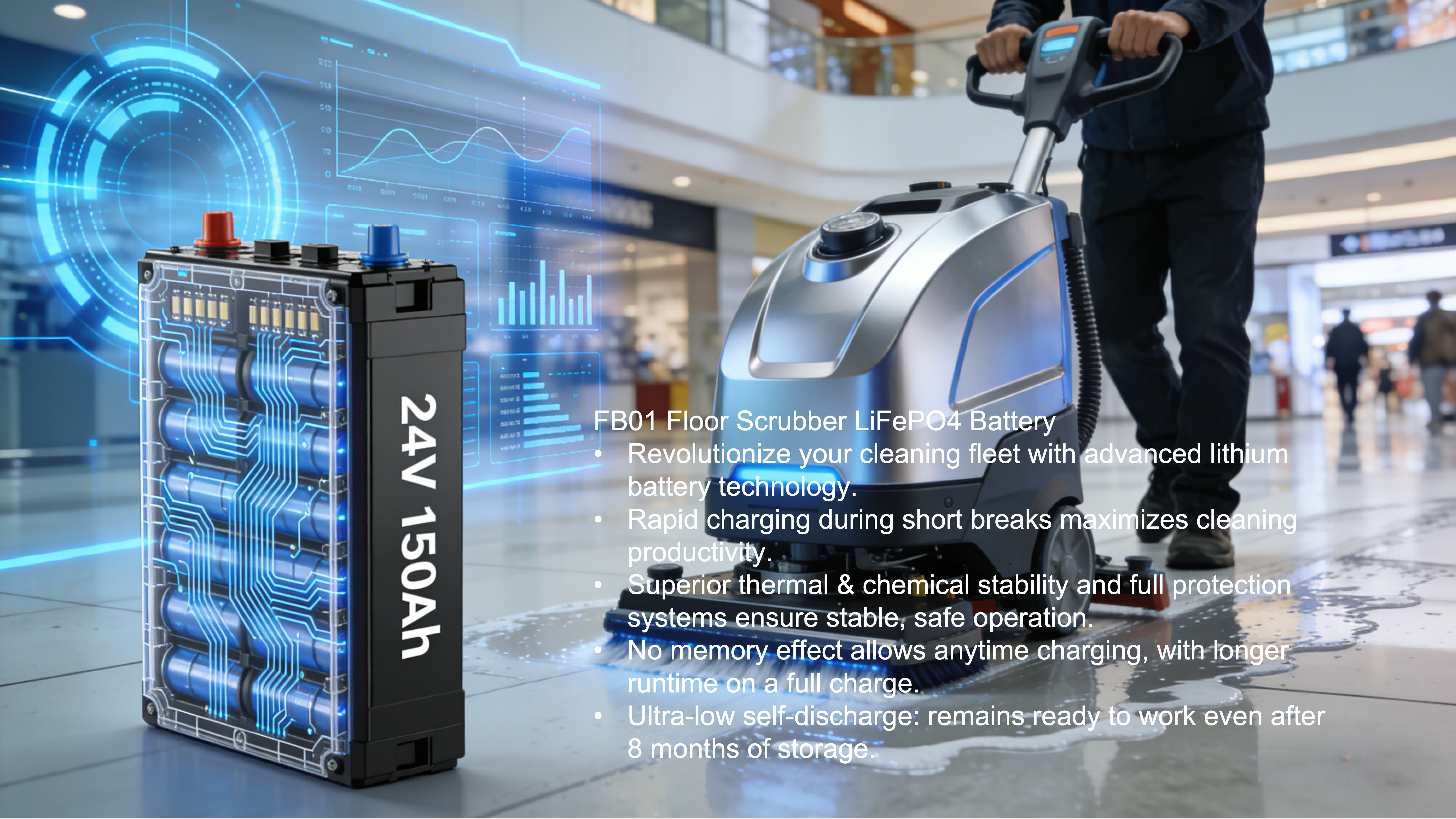
The Surlon Power FB07 is a 24V 280Ah LiFePO4 battery pack built for ride-on and walk-behind floor scrubbers, sweepers and the wider family of heavy cleaning machines that have been running lead-acid banks. Behind that rating sits a 25.6V nominal pack holding just over seven kilowatt-hours, sealed in a steel case rated IP65, with the battery management system built into the pack rather than added alongside it.
The format is deliberate. The case takes up roughly the compartment a lead-acid set occupied, so a machine can be converted without re-engineering the tray, and the pack weight is set per order so there is no counterweight to bolt on. Operators notice it in the steering: the scrubber keeps the balance it had before.
Facility teams buy it to take the watering routine out of the workshop and to stop sending machines home half-charged. OEMs building new scrubbers buy it because the enclosure, connector, charger profile and BMS settings can be agreed around their own machine instead of designing the machine around a catalogue battery.
Before a conversion, confirm the machine's voltage window, the compartment drawing and the charger's charging profile with our team. The specification table below covers the electrical and mechanical figures; the sections after it explain what each one means on a working scrubber.
Product Advantages
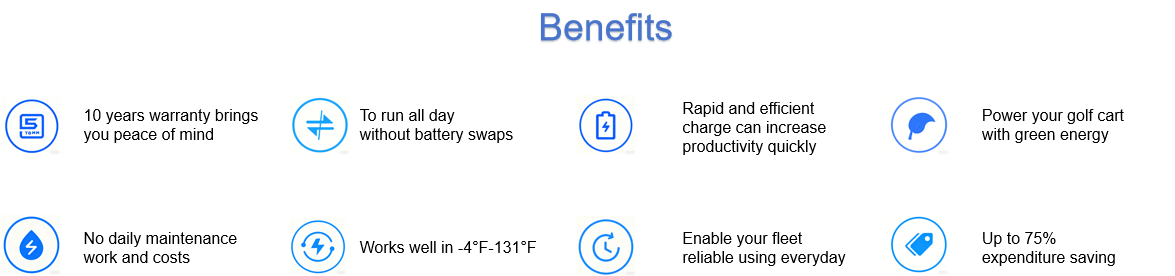
- Finish the route on one pack. Crews stop planning around a mid-shift battery swap: a 24V battery for heavy cleaning machines of this size is bought precisely so the machine completes its round and goes on charge afterwards.
- Take the maintenance routine out of the workshop. No water topping-up, no acid deposits to scrub off terminals, no equalising charge to schedule — that labour goes back into the cleaning work.
- Even output as the charge falls. Brush pressure and suction hold deeper into the discharge, so the last aisle is cleaned like the first.
- Built for a wet deck. The sealed steel case and IP65 rating are there for scrubber conditions, where water, detergent and dust are constant companions.
- Partial charging suits multi-shift sites. A top-up over a break does not carry the penalty that repeated partial charging puts on older chemistries.
- A lithium battery vendor you can put in a tender. Pack, BMS and documentation come from one factory, so the technical file describes the unit you actually receive.
Specifications
| Parameter | Specification |
|---|
| Nominal voltage / discharge voltage range | 24V (25.6V) |
| Nominal capacity | 280 Ah |
| Stored energy | 7.16 kWh |
| Cycle life | More than 4,000 deep cycles |
| Continuous charge / discharge current | 0.5C |
| Maximum discharge current | 2C |
| Charge temperature | 32°F to 131°F (0 °C to 55 °C) |
| Discharge temperature | -4°F to 140°F (-20 °C to 60 °C) |
| Storage (3 months) | -4°F to 140°F (-20 °C to 60 °C) |
| Storage (1 year) | 32°F~95°F ( 0°C~35°C) |
| Dimensions (L x W x H), for reference | 22.83 x 14.17 x 11.42 in (580 x 360 x 290 mm) |
| Weight, no counterweight | Customized |
| Casing material / IP rating | Steel / IP65 |
Use Scenarios
- Department stores and mall floors, after hours. Contract crews move through a shopping centre once the shutters come down, and a 24V battery for heavy cleaning machines has to hold its output from the first atrium to the last service corridor. The pack charges during trading hours while the scrubber is parked.
- Hospital wards and corridors. Cleaning windows sit between patient rounds, so most sites charge in short bursts rather than a full cycle. Partial charging suits that rhythm, and there is no electrolyte to handle inside a clinical building.
- Distribution centres and warehouses. Wide aisles, long runs and airborne dust; the sealed case keeps dust out of the pack while the machine works a full shift between charges.
- Food and beverage plants. Production halls washed down with water and detergent are the reason the case is steel and rated IP65 rather than a moulded shell.
- Airport and transit terminals. Daytime cleaning in public areas pulls machines out of service only briefly, so the pack is charged overnight in the maintenance bay and finished during the quieter afternoon window.
- Property maintenance and municipal fleets. Several scrubbers of different ages share one stores shelf, which is where a single 24V specification across the 24V machines pays for itself.
- New scrubber builds. OEMs fit the pack during assembly, with connector, charger and BMS settings agreed at the drawing stage rather than at the end of the line.
High Energy Storage Capacity
Amp-hours only mean something next to a voltage. On this 24V 280Ah LiFePO4 battery pack, 280Ah at 25.6V nominal works out to 7.16 kWh, and that energy figure is the honest way to compare it with the lead-acid bank being replaced, because the two technologies are usually quoted differently and a 24V set of one make is not the same amount of stored energy as another.
Energy is not the same as runtime. A scrubber spends its energy in three places: the brush motors working under pressure, the vacuum that lifts the dirty water, and the drive motor moving the machine. Floor type, soil load, brush pressure setting and how much water the operator lays down all move the number. A sealed concrete aisle draws far less than a rough floor with a heavy film of oil and grit. Average current draw multiplied by the hours in a route is the practical way to size a machine or a fleet, and it beats reading the capacity label on its own.
Keep a margin for the last hour. Routes rarely run to plan. Leaving a slice of the pack in reserve means the machine finishes at full brush pressure instead of being nursed home on the last aisle, and it keeps the discharge away from the cut-off point that the BMS enforces at the bottom end.
Deeper discharge is not free. Running the pack down to empty every night costs more life than charging it at the end of a route with capacity to spare, which is worth knowing when the same pack has to serve a site for years rather than one season.
Runtime and Endurance
- Charging fits between shifts. A full charge on the correct profile returns the pack to service for the next shift, and opportunity charges over breaks top it up without a memory penalty to manage.
- The cycle count carries the investment. The cycle life in the specification table is a deep-cycle figure, the kind that matters when a machine runs five or six nights a week, year after year, rather than a laboratory ideal case for shallow cycling.
- A 10-year design life is the target. Surlon Power builds this pack to a stated 10-year design life, which is why the enclosure and terminal hardware are specified for repeated service rather than a single installation.
- Runtime you can plan against. Record hours per charge for the first two weeks on each machine. That baseline tells you whether a route needs a larger pack or a second charger far better than the label number alone.
- Rotation across a fleet. Where two machines share a long route, a second pack keeps both working while one charges, and the pair wears evenly instead of one pack absorbing every cycle.
- What actually shortens runtime. Cold floors, high brush pressure, heavy soil and a worn squeegee forcing extra passes all cost energy. When a machine suddenly runs short, check the setup before blaming the pack.
Charge and Discharge Capability
The 0.5C continuous rating is the number to design around. On a 280Ah pack that is roughly 140A held continuously in either direction — enough headroom for a scrubber pulling brush, vacuum and drive at the same time without sitting at its ceiling all shift. The 2C maximum is a peak figure, not a duty point: it covers the current spike when a brush motor starts under load or a machine climbs a ramp. How long that peak may last, and how often it may repeat, depends on the BMS settings agreed for your configuration, so treat it as a limit to confirm rather than a working current.
Peak figures are where conversions go wrong. A machine's nameplate current says little about what happens in the half second after the brush switch closes. Ask the maintenance team for the controller's current limit, the fuse rating already fitted and the cable size, and send those with the machine model; we will check the configuration against them before the order is confirmed.
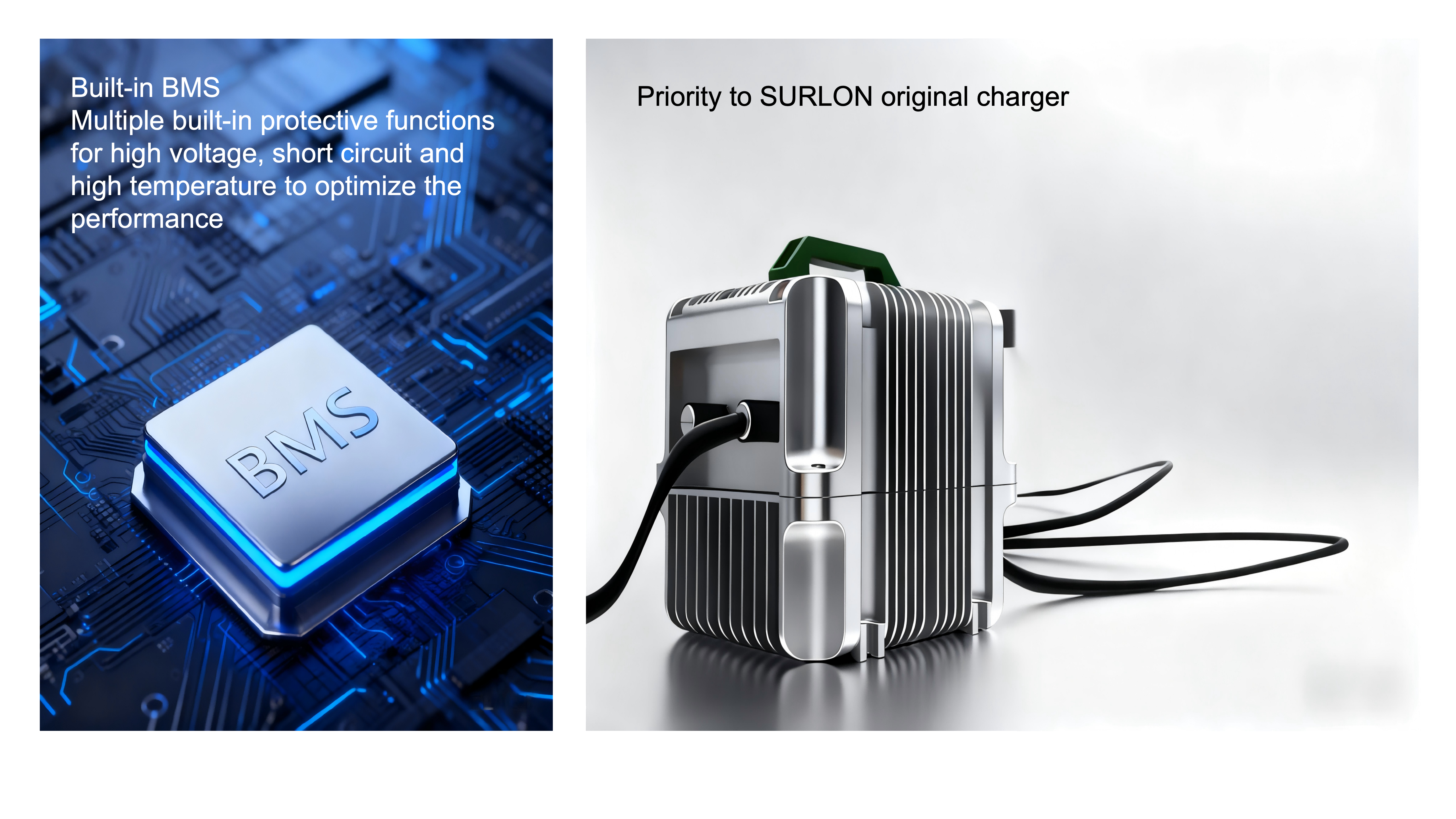
Charging follows the same logic. The pack accepts charge at the continuous rate, but the charger's profile decides how the final part of the cycle is finished, and a lead-acid profile will not do the job. Confirm the output voltage and cut-off for a 25.6V LiFePO4 pack before the first charge, and check that the charger can be set rather than only replaced.
Casing and Ingress Protection
- Steel, not a moulded shell. The case is steel, which is why the pack tolerates being nudged against machine frames, kerbs and loading ramps during a route instead of cracking at the first knock.
- IP65, read correctly. The rating means dust-tight and protected against water jets. It does not mean the pack may be submerged or left standing in a pool of wash water, and it does not replace common sense around a pressure washer.
- Handles on the case sides. The photographs show the silver handles; use them for a two-person lift and keep the pack level while it is carried.
- Terminal lugs on the side of the case. Keep the terminal area dry and clean, check the hardware at each service, and confirm the cable lugs your machine needs before the first fit rather than during it.
- A front label an operator can read. The case front carries the pack voltage and capacity along with the handling warning, so a handover briefing can point at something physical instead of a manual page nobody opens.
- Inspect at every service interval. Look for case damage, wear at the cable entries, loose terminal hardware and water sitting in the compartment. Small faults caught at a service are cheaper than a mid-shift stoppage.
- Leave the mounting as it was designed. Reuse the machine's existing restraint and confirm clearance for the handles and cable route; the pack should not be able to shift when the scrubber turns or stops sharply.
Operating Temperature Range
Charging has a floor at freezing. The charging window is set out in the specification table, and the bottom of that window is the part operators get wrong. A pack that has stood in a cold yard overnight needs to come up to temperature before it will accept charge; forcing a charge into a frozen pack is the fastest way to shorten its life. Sites that run winter routes should plan a charging bay above freezing rather than relying on the machine sitting where it stopped.
Discharge reaches further than charge. Machines can keep working in chilled stores and cold loading bays down to the lower discharge limit, but expect usable capacity to drop while the pack is cold. A route that finishes comfortably in summer can come up short in January, and the fix is usually a shorter route or a warmer parking spot rather than a different battery.
Storage has two clocks. A pack parked for a few months sits inside the wider storage band, while one laid up for a year needs the narrower, more moderate band. If a machine is going to stand idle through a quiet season, ask us for the storage state of charge and inspection interval recommended for this pack rather than applying a rule of thumb from another battery.
Condensation is the quiet risk. Bringing a cold pack into a warm wash bay puts moisture on the case and terminals. Let it equalise before charging, and wipe the terminal area dry. On hot sites, keep the compartment ventilated and avoid putting a machine straight on charge after a long shift in a sun-loaded cabin.
Customization and Fit
- Weight built to your machine. The specification lists the weight as customized with no counterweight: the pack is ballasted to sit in the machine the way the lead-acid set did, so traction and steering stay familiar to the operators.
- Case dimensions are a reference, not an assumption. The envelope in the table is a starting point; check it against the bay floor, the cover above it, the handle clearance and the cable route before ordering.
- Connector, cable and BMS settings agreed per project. Send photographs of the existing connector and its pinout, and tell us the charger you intend to use, so the interface is settled on paper first.
- Labels and branding. Customer labels and branding can be discussed with our team as part of the order, which matters when the packs go into machines carrying your own name.
- Other capacities in the same family. A 24V 72Ah pack covers shorter routes, a 24V 410Ah pack covers the largest machines, and 36V packs at 72Ah, 105Ah and 150Ah serve machines built on a 36V system. Voltage class comes first; capacity second.
- As a lithium battery vendor we work from your drawing. Send the compartment drawing, connector photos, charger details and route length, and the configuration review starts from your machine instead of from a stock list.
- Sample before a fleet order. Ask your sales contact about sample availability and the acceptance checks your maintenance team wants to run on the first unit.
Installation and Commissioning
- Isolate the machine and photograph the battery bay, cabling, restraint and terminal hardware before anything is disconnected; those photographs become the reference for the whole conversion.
- Offer the new case into the bay and check the footprint, the height under the cover, the handle clearance and the cable route before lifting it into position.
- Connect the cable lugs with the hardware and torque specified for your machine, polarity confirmed against the labels, and keep the terminal area dry throughout.
- Set the charger to a 25.6V LiFePO4 profile covering finish voltage and cut-off, and test it on the bench before the first in-machine charge.
- Power up and confirm state-of-charge indication, low-voltage cut-off behaviour and any interlock or hour-meter function before the first cleaning run.
- Run one shift and record hours worked, finishing charge and any fault indication; that baseline is what every later comparison is measured against.
- Send the baseline and charger settings to our engineers for a commissioning review. We stay involved through charger configuration, cable routing questions and the first weeks of service, and we can talk your technician through the sequence if the machine behaves unexpectedly.
Certification and Safety
UN38.3 covers transport: it is the test regime that decides whether a lithium pack can be offered to a carrier at all, and the paperwork that goes with it is what your forwarder will ask for. UL 1973 addresses the battery system used in industrial and stationary applications, covering construction and abuse tolerance rather than the machine it is fitted to. UL 9540A looks at how a cell-level failure propagates, which is the evidence fire engineers and insurers now expect to see for installed energy storage.
Inside the case, the integrated BMS is the first line of protection. It guards against overcharge, over-discharge, short circuit and over-temperature, and it monitors the cells rather than only the pack terminals. That is what turns an operator error into a shutdown instead of a repair.
Documents follow the configuration. A report issued for one build does not automatically cover a variant with different cells, enclosure or BMS settings, so ask for the paperwork that matches the model and revision you are buying. Transport classification, packing and labelling are also confirmed per shipment, because they depend on the route as well as the pack.
Ordering and Delivery
- Machine details. Make, model and year for every scrubber in scope, plus the controller's continuous and peak current with the duration of the peak. A 24V battery for heavy cleaning machines is only matched once the electrical load is known.
- The bay, in drawings or photographs. Compartment dimensions, fixing points, cable route and connector pinout; a tape measure in the photograph saves a round of questions.
- Charger information. Make, model and the label showing output voltage and charging profile, so we can say whether it can be re-set or needs replacing.
- Route and shift pattern. Hours per shift, floors cleaned and the charging window available between shifts.
- Voltage class check. Confirm the machine is a 24V system. A 36V scrubber needs one of the 36V packs in the range, not this one.
- Quantity and schedule. How many packs for the first order and how the fleet rolls out; sample availability and timing are confirmed with your sales contact.
- Destination and documents. Which approvals and transport papers your market or customer requires, so the file matches the configuration being shipped.
- Commercial terms. Price, lead time, warranty period, payment terms and packing are set out in the quotation for your order, and the current specification sheet and dimension drawing can be sent for your file on request.
Charger Compatibility
- The charger you already own can often stay, but only once its profile has been checked against the pack. What decides it is the finish voltage, the charge current and the cut-off point where the cycle ends, plus whether the unit offers equalising, desulphation or a float stage that this chemistry should never see.
- Configurable chargers are the straightforward case. Selector switches, dealer-programmable curves and dedicated lithium settings can be set to suit the 25.6V class of this pack; tell us the make, model and the selector positions available, and we will confirm the settings for the build you order.
- Sealed single-profile units are the other case. A charger built only for flooded lead-acid, with no way to change its curve, will not finish this pack properly, and a replacement is usually the cheaper route than trying to adapt the battery to a lead-acid algorithm.
- Charger output sets the recharge window. The pack accepts continuous charge at 0.5C, so a higher-output charger returns it to service faster between shifts, while a small maintenance unit will not put a full shift's energy back overnight. Match the charger to the hours the machine actually stands still.
- Built-in chargers on ride-on scrubbers need a separate check. Where the charger lives inside the machine, confirm whether its algorithm can be reprogrammed for lithium or whether the module has to be replaced, and verify afterwards that the charge interlock, hour meter and dashboard charge indicator still read correctly.
- Charging has a temperature floor at 32 °F (0 °C). A machine that has stood in a cold yard overnight needs to come up to temperature before it goes on charge; if a charger keeps pushing current into a cold pack, the BMS interrupts it, and repeated cold charging is the quickest way to shorten pack life.
- The connection between charger and machine matters as much as the curve. Confirm plug type, pin arrangement and polarity at the charging port, particularly where the old lead-acid set used a different socket layout, and check cable gauge against the charger's rated output.
- Opportunity charging is fine, float charging is not. Topping up over a break between routes suits LiFePO4 packs, but each cycle has to terminate at the correct cut-off rather than dropping into a float voltage, and desulphation or equalise modes should never be run on this battery.
Impressive Endurance Performance
A full charge is built to carry commercial and industrial floor scrubbers through long, heavy-duty shifts, so the machine keeps working instead of sitting at the charger. Extended runtime per charge means fewer stops mid-route, steadier productivity across large floors, and recharge cycles that fit around your cleaning schedule rather than dictating it. If you want to know what that looks like on your own scrubber model and duty cycle, tell us how you run your shifts and we will walk you through the expected runtime before you order.
Technical Support & Model Matching
Technical questions reach the people who build the packs. Our engineering group in Shenzhen reviews your device's voltage window, load profile, enclosure space and charger before proposing a configuration; our sample group then builds units so you can validate fit and runtime before production. Cell selection, BMS design and pack assembly stay in-house, with quality checks in process and at final inspection, and a documentation team handling certificates, test reports and shipping papers. When a unit behaves unexpectedly in the field, our engineers help trace the fault and advise on installation and commissioning.
FAQ
What makes this pack a better fit for a scrubber than the lead-acid bank we run now?
Three things change on the machine. First, usable energy: a LiFePO4 pack can be taken deeper into its discharge without the capacity loss that shortens a lead-acid bank's working life, so more of the rated energy reaches the brush and vacuum. Second, the voltage holds flat through the discharge, so brush pressure and suction stay consistent instead of fading over the route. Third, the routine disappears: no water topping-up, no terminal corrosion to clean and no equalising charge to schedule, with the integrated BMS handling overcharge, over-discharge, over-temperature and short-circuit protection in place of the regular checks a lead-acid set needs.
Will it fit the compartment our lead-acid batteries sit in?
Every conversion is a physical fit question first: a 24V battery for heavy cleaning machines has to clear the bay floor, the cover above it and the cable route before anything else matters. The reference envelope is in the specification table; check it against your compartment, including the handles on the case sides, and remember the final weight is customized to your machine so the scrubber keeps its balance without extra ballast. Send the compartment drawing, or a few photographs with a tape measure in frame, and our team will compare them with the current build.
Can we keep the charger that came with the machine?
Not automatically. The charger has to suit a 25.6V LiFePO4 pack, and what matters is the finish voltage and the cut-off behaviour rather than the nominal output alone, because a profile written for lead-acid will not charge this pack correctly. Send the charger make, model and a photograph of its label; we will tell you whether the existing unit can be set to the right profile or whether a replacement is the cleaner route. Do not run a lead-acid profile on the pack on the assumption that it is close enough.
What happens if an operator runs the pack flat or overloads the machine?
The integrated BMS cuts the pack off before an over-discharge or over-current event can damage the cells, and it does the same on over-temperature and short circuit. A machine pushed too hard loses power rather than cooking the pack; the operator should stop, let it rest and report it instead of repeatedly resetting. Repeated cut-offs on the same route usually point to a machine fault such as a dragging brush, a blocked squeegee or a failing motor, so note when it happens. Recovery steps and the protection thresholds for your configuration come with the pack documentation.
Can one pack type serve a mixed fleet of scrubbers?
Only within the same voltage class. The 24V 280Ah LiFePO4 battery pack suits machines built around a 24V system; a 36V scrubber needs a 36V pack, and swapping voltage classes is not a wiring exercise. Within the 24V class the same case can be ordered with a weight to suit each machine, and shorter routes are often covered by the 24V 72Ah pack in the family. Send the list of machines with make, model and year and we will tell you which ones this pack covers.