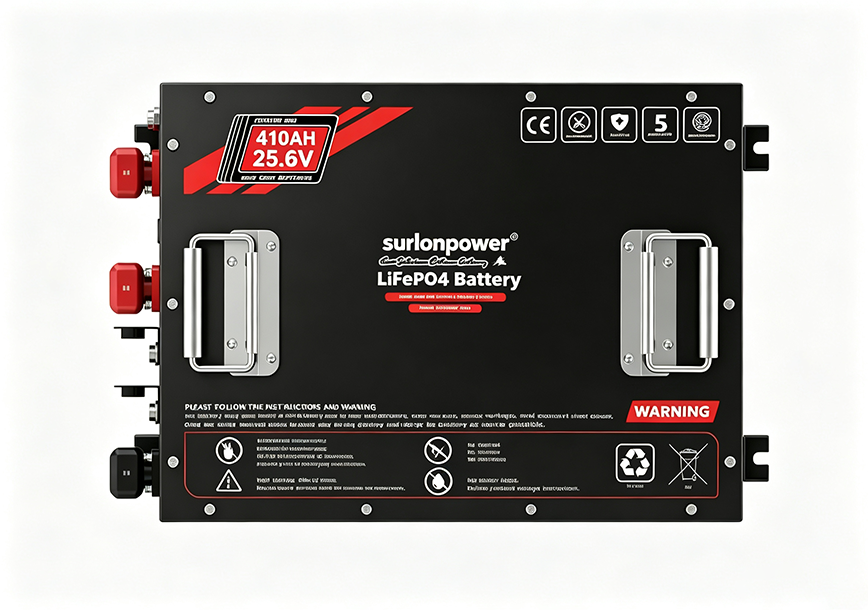
Product Overview
The 24V 410Ah LiFePO4 battery behind the FB09 is built for the 24V-system class of floor cleaning equipment: 25.6V nominal, 410Ah nominal capacity and 9.84kWh of stored energy held inside a steel enclosure. LiFePO4 is the chemistry chosen here because a scrubber works a full shift, charges overnight and repeats that cycle for years — the pack is specified for stable output and a long cycle count rather than for the smallest possible case.
This is a project pack rather than a shelf item. Dimensions and weight are customized because battery bays differ from one scrubber platform to the next: deck height, ballast position, cable routing and terminal access all change the enclosure. You send the compartment drawing and the connector layout; the pack is built to that envelope, and the same drawing becomes the reference for every later order.
Most installations are ride-on and walk-behind scrubbers, sweepers and commercial cleaning machines working in warehouses, distribution centres, hospitals, shopping centres and factory floors. In those sites the move away from lead-acid is usually about maintenance and shift continuity: no watering, no equalising charge, no acid deposits on the terminals, and a pack that can be opportunity-charged between shifts.
Every order is tied to a documented configuration. Rated voltage, capacity, current limits, enclosure arrangement and connector details are recorded against the revision you approve, so a repeat order matches the first one instead of drifting.
One point worth stating plainly: a 24V-system label on the old battery does not make this a fit-anything part. The pack is a matched component, reviewed against your machine's voltage window, charger, compartment and interface before it is built.
Specifications
| Item | Specification |
|---|
| Battery Type | LiFePO₄ Lithium Battery |
| Nominal Voltage | 25.6V (24V System) |
| Nominal Capacity | 410Ah |
| Stored Energy | 9.84kWh |
| Continuous Charge/Discharge Current | 0.2C |
| Maximum Discharge Current | 1C |
| Charging Temperature | 0°C ~ 55°C |
| Discharging Temperature | -20°C ~ 60°C |
| Storage Temperature (3 Months) | -20°C ~ 60°C |
| Storage Temperature (1 Year) | 0°C ~ 35°C |
| Enclosure Material | Steel |
| IP Rating | IP65 |
| Certifications | UN38.3 / UL 1973 / UL 9540A |
| Dimension | Customized |
| Weight | Customized |
| Cycle Life | Over 4,000 cycles |
Machine and Charger Compatibility Review
A 24V battery pack for industrial floor scrubbers only works when four things agree: the machine's voltage window, the charger's profile, the compartment, and the connector. We review all four before a pack is released for build.
Voltage window. The controller has an operating range and a low-voltage cut-off. LiFePO4 sits at a higher and flatter voltage than a lead-acid string of the same nominal class, so a controller set up for lead-acid may read the pack as full for too long or cut out early. Send the controller's permitted input range and its cut-off behaviour, and the discharge curve is checked against it.
Charger profile. Give us the make and model of the charger, its output voltage, its charge curve and how it terminates. Lithium charging is constant-current then constant-voltage with a defined cut-off, and a lead-acid charger with a float or equalise stage is not automatically suitable. Where a charger change is part of the project, we say so before the order rather than after delivery.
Compartment and mass. The enclosure is built to your drawing, but the machine also has to carry it. Floor loading, fixing points and the clearance needed to lift the pack in and out all count, and a steel enclosure is often the right answer for a bay that was designed around a lead-acid set in the first place.
Connector, polarity and interface. Connector type, pinout, cable length and polarity are agreed in writing. Any communication or interlock the machine expects — a key-switch signal, a relay, a controller handshake, a charge-inhibit line — is confirmed with the machine supplier. If the machine needs an interface the standard configuration does not carry, that becomes a separately agreed build.
Compatibility is a review, not a claim. Once those four points are confirmed in writing, the configuration is fixed and the drawing is issued against it.
Electrical Load and Operating Voltage
- Continuous duty sits at 0.2C. The continuous charge and discharge rating is the band a scrubber works in while scrubbing, squeegeeing and travelling between aisles. Size the machine's normal duty around it rather than around the peak figure.
- 1C is a peak, not a cruise. The maximum discharge current is listed at 1C, which covers brush-motor start-up and pump kick-in. Treat it as a short event, and tell us how long the surge lasts and how often it repeats so the limits can be confirmed for the exact configuration.
- The voltage curve is flat, then steep. On this 24V 410Ah LiFePO4 battery the voltage holds steady through most of the discharge and falls quickly near the end. Controllers that estimate state of charge from voltage alone will read differently than they did with lead-acid.
- Low-voltage cut-off needs resetting. A cut-off chosen for a lead-acid string can leave usable capacity unused or let the pack run too deep. Set it for the lithium discharge curve and have the setting confirmed by the machine supplier.
- Runtime comes from measured current. Stored energy is a nominal figure on a defined test basis; the shift length you actually get depends on average current, floor type, squeegee pressure, travel speed and how often the machine stops. Log current over a real cleaning cycle before committing to a shift plan.
- Hot floors change the numbers. A sunlit loading bay or an unventilated plant room narrows the current the pack should be asked for, so leave margin in the duty cycle during summer shifts.
- Long cable runs add resistance. Check cable cross-section against the current you plan to draw; undersized wiring shows up as voltage sag under load, not as a battery fault.
Installation, Connectors and Communication
- Start with the bay drawing. As a cleaning machine battery supplier we build to the envelope you send, so the compartment drawing comes first: internal dimensions, deck height, fixing points, lifting clearance and the cable route.
- Fix the connector before the enclosure. Connector type, pinout, polarity and cable length are agreed in writing. A mating connector that arrives without its pinout confirmed is the most common reason a retrofit stalls on site.
- Agree any interface with the machine supplier. If the scrubber expects a key-switch signal, a relay, a controller handshake or a charge-inhibit line, confirm it with the equipment maker so it is built into the agreed configuration.
- Plan the lift and the restraint. A steel-enclosed pack is heavy and it sits in a machine that vibrates, so agree lifting points and the bracket or strap arrangement rather than reusing the original lead-acid hold-down.
- Check clearance around the terminals. Leave room for cable bends, a fuse and a torque wrench; a terminal that cannot be reached is a terminal that will be left loose.
- Commission in order. Polarity, insulation, terminal torque and connector seating first, then a first charge on the approved charger with someone watching temperature and termination behaviour.
- Record what was fitted. Note the pack revision, the charger used and the cut-off setting in the machine's service file, so the next replacement or the next machine in the fleet matches without another drawing exercise.
Charging and Cleaning Environment
- Charge inside the charging window. Charging is rated from 0 °C to 55 °C. A cold loading bay in winter or an unventilated plant room in summer can sit outside that window, and charging outside it is what shortens pack life.
- Discharge runs wider. The discharge window reaches further in both directions than the charging window, which covers cold-store work and hot factory floors, but the current you should ask for narrows towards the ends of that range.
- Get the charger approved by both sides. Send the charger model and profile; the battery side and the machine supplier should both accept the charging limits and termination method before the first charge, and a charger change may form part of the project.
- The enclosure rating has limits. Dust and water-jet protection applies within the stated conditions. It is not permission to immerse the pack, steam-clean it or pressure-wash the installation, and foam or chemical spray should not be directed at the charge inlet.
- Wet floors are the normal case. This 24V battery pack for industrial floor scrubbers lives on a wet machine, so route the charge cable clear of the squeegee path and keep the inlet covered when it is not in use.
- Vibration is continuous. Scrubber decks vibrate all shift. Check that cables are clipped, connectors are locked and the pack is restrained, and put that check into the weekly routine rather than the annual service.
- Ventilate the charging area. Charge where air moves, keep the bay away from solvent and chemical storage, and keep it clear of the machine's wash-down zone.
Model Documents and Certification Scope
| Document | What it establishes |
| Current specification sheet | Rated voltage, capacity, energy, current limits and the exact revision supplied |
| Dimension drawing | Compartment envelope, fixing points, terminal positions and connector layout |
| Operating and storage instructions | Charging, storage, handling and inspection guidance for the pack |
| Model test summary | The conditions behind the energy, cycle life and ingress figures |
| UN38.3 documentation | Transport test summary together with the lithium shipping papers for your destination |
| UL 1973 and UL 9540A scope | What each document covers, and for which configuration it was issued |
Sample Evaluation and Project Review
- Agree what a pass looks like. Before a sample ships, settle the acceptance criteria with your engineering team: fit, connector seating, charging behaviour, runtime under a defined duty, and the temperature the machine will actually see.
- Check the sample against the drawing. Model, revision, dimensions, weight, terminal positions and cable clearance — a sample that matches the drawing is the only one worth scaling.
- Run it on the real charger. Confirm charging behaviour, termination and temperature rise with the charger you will use in service, not a bench supply.
- Run it on the real controller. Validate the voltage window, the cut-off point and the load peaks with the machine's own controller and wiring in place.
- Measure a real shift. Time a full cleaning cycle at the machine's normal settings and record current, runtime and the state of charge at the end; capacity on its own is not a runtime figure.
- Review the service routine. Operating and storage instructions, inspection points and the cable-and-fixing checks should be written into the fleet routine before the first machine goes into service.
- Send the project brief for production review. As a cleaning machine battery supplier we need the machine model, voltage limits, steady and peak current with duration, shift length, charger details, compartment drawing, connector and communication requirements, sample quantity, expected volume and destination market.
- Confirm the commercial details with your sales contact. Availability, lead time, packing and shipping arrangements are confirmed for the quoted configuration rather than carried over from a previous order.
Repeat Order Configuration
- When the enclosure is built to your compartment, the approved drawing, connector schedule, BMS settings, label text and packing details are combined into one configuration reference for the FB09 24V 410Ah LiFePO4 battery. A repeat order is placed against that reference, not against a general product name.
- The compartment drawing is given a revision number when you approve it. Production checks the enclosure dimensions, terminal positions, fixing points and cable exits against that revision; if the bay changes, it becomes a new revision and a new build rather than a silent alteration to an existing order.
- Keep the first accepted sample and its inspection record. On later batches, the same key points are compared with that reference: overall size, weight, terminal layout, connector type and cable length, followed by a final inspection before packing.
- Connectors, cable lengths, BMS settings and enclosure details are not substituted because another part is easier to obtain. Any proposed change is put to you in writing with its effect on fit, current limits and the document set before it enters a repeat batch.
- Each pack carries the model, configuration reference and revision on its label, and the packing list repeats the same identity. A service team can then match a replacement to the machine that was commissioned rather than to a similar-looking battery.
- Add the configuration reference and machine number to the machine's service record. When you reorder, quote that reference so sales and engineering pull the same drawing, connector schedule and documents instead of rebuilding the specification from memory.
- For a mixed fleet, keep one configuration reference per scrubber platform, not one per order. Machines that share a bay and interface can share a pack; a platform with a different bay, controller or charger gets its own reference, which prevents a near-match from being fitted across the fleet.
- Check the first delivery against the approved drawing and reference sample before releasing packs to machines: label, overall dimensions, terminal positions and connector. Record the result, because catching a picking or transit error at the stores door is cheaper than finding it with a scrubber stripped down on a ward floor.
Technical Support & Model Matching
Technical questions reach the people who build the packs. Our engineering group in Shenzhen reviews your device's voltage window, load profile, enclosure space and charger before proposing a configuration; our sample group then builds units so you can validate fit and runtime before production. Cell selection, BMS design and pack assembly stay in-house, with quality checks in process and at final inspection, and a documentation team handling certificates, test reports and shipping papers. When a unit behaves unexpectedly in the field, our engineers help trace the fault and advise on installation and commissioning.
FAQ
Is FB09 a drop-in replacement for a lead-acid battery?
Not automatically, and the 24V-system label is not enough to decide it. A lead-acid set and a 24V 410Ah LiFePO4 battery behave differently at the controller: the discharge curve is flatter, the low-voltage cut-off needs to suit lithium, and the charger has to be approved for the new pack. Fit matters as much as voltage — compartment dimensions, mass, fixing points, connector polarity and any control interface all have to line up. Send the machine model and the bay drawing and the pack is reviewed against them before anything is ordered.
Can the pack be customized?
Yes. Dimensions, weight, connectors, cable lengths and the electrical specification are all set for the machine, and communication or interlock requirements can be discussed as part of an OEM design. The quotation identifies the approved configuration and the documents that go with it, because a change to the build can change both the performance figures and the scope of the paperwork.
Which documents should we request before ordering?
Ask for the current specification sheet and the dimension drawing for the revision you will actually receive, the operating and storage instructions, and the model test summary that sits behind the energy, cycle life and ingress entries. If a sample is part of the project, agree the acceptance criteria in writing at the same time so the trial has a defined pass and a defined fail.
Which machines is this battery intended for?
It is a 24V battery pack for industrial floor scrubbers: ride-on and walk-behind machines, sweepers and commercial cleaning equipment that run a 24V-system electrical architecture. It is not a fit-anything part — the machine model, controller, charger and compartment are reviewed first, and the enclosure is built to the bay you have rather than to a nominal size.
What do the UN38.3, UL 1973 and UL 9540A entries cover?
They are three different things and they are not interchangeable. UN38.3 is the transport test summary for shipping lithium batteries. UL 1973 addresses the battery system for stationary and similar applications. UL 9540A relates to thermal-runaway fire testing at system level. Each is issued for a specific configuration and scope, so ask for the report that matches the pack you are buying and check it against your destination and your customer's requirements; an entry on a specification sheet is not by itself an approval for a finished machine.
Why are the dimensions and weight listed as customized?
Because a scrubber bay is rarely a standard size. Deck height, ballast position, cable routing and terminal access differ between machines, so the enclosure, terminal layout and internal arrangement are set from your compartment drawing. That also means the drawing you approve becomes the reference: a later machine with a different bay is a different build, not the same pack moved across.
How should the pack be stored when a machine sits idle for months?
Use the storage band that matches the length of the idle period — the one-year band is narrower than the three-month band, so a pack parked over a winter belongs in a dry, temperate store rather than a cold bay. Keep it part-charged rather than empty, leave the terminals covered, and give it a top-up charge before the machine goes back into service.
Does a lithium scrubber battery still need maintenance?
It removes the lead-acid chores — no watering, no equalising charge, no acid deposits to clean off the terminals — but it does not remove inspection. Cables, connector seating, terminal torque and the mechanical restraint need checking on a routine interval, and the charge inlet should be kept dry and clear. Build those checks into the machine's service schedule from the first installation rather than waiting for a fault.