


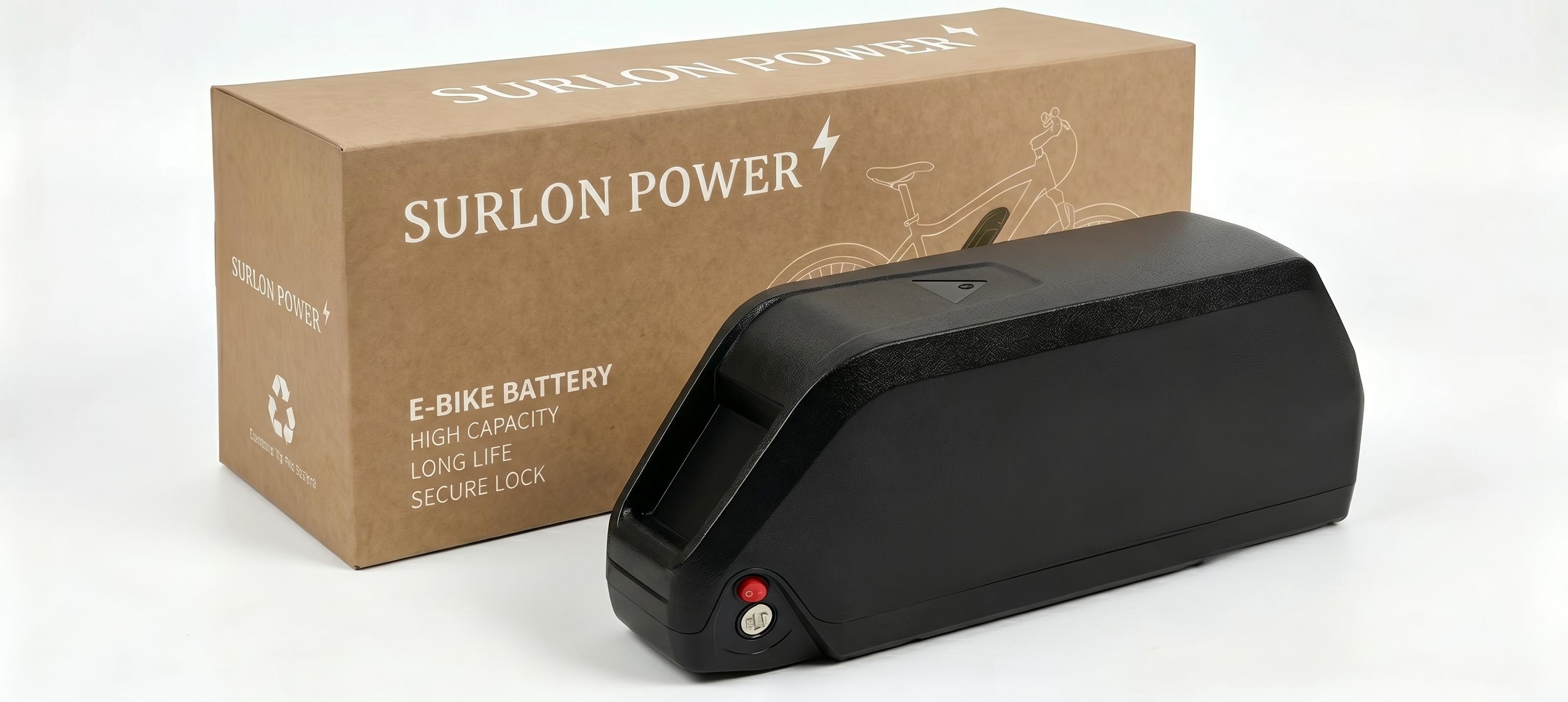
The Surlon Power NCM Hailong e-bike battery is a 48 V lithium-ion pack built into the Hailong down-tube case — a down tube battery for electric bicycles that sits along the frame rail rather than in a rear rack or a custom box. It is made in 20 Ah, 25 Ah and 30 Ah builds, so one frame design, one bracket and one charger family can cover a short-range city model and a long-range trekking model without a second frame drawing.
Bike makers use it as a repeatable power module: cells, management board, wiring and case arrive assembled and tested, and the next batch fits the same bracket. Retrofit workshops use it to move an older bike off a failing pack onto NCM cells with a proper battery management system. Rental and shared fleets use it because the charge indicator, the key lock and the charging socket all sit on the same face of the case, which keeps a battery swap quick and a service routine short.
The housing is a hard shell with an angular profile, closed by a key lock, with a push-button charge indicator on the top face and a rubber cover over the charging socket. The discharge lead leaves at the base, where the case meets the frame bracket. Inside, NCM cells are arranged in series and controlled by a battery management board.
Because the case, the bracket pattern and the wiring are familiar to dealers, this pack folds easily into an existing range: one bracket, two or three capacity steps, one service procedure. As a custom e-bike battery manufacturer we also take it beyond the stock builds — a different connector, a different management board, a different case — when a frame or a controller asks for it.
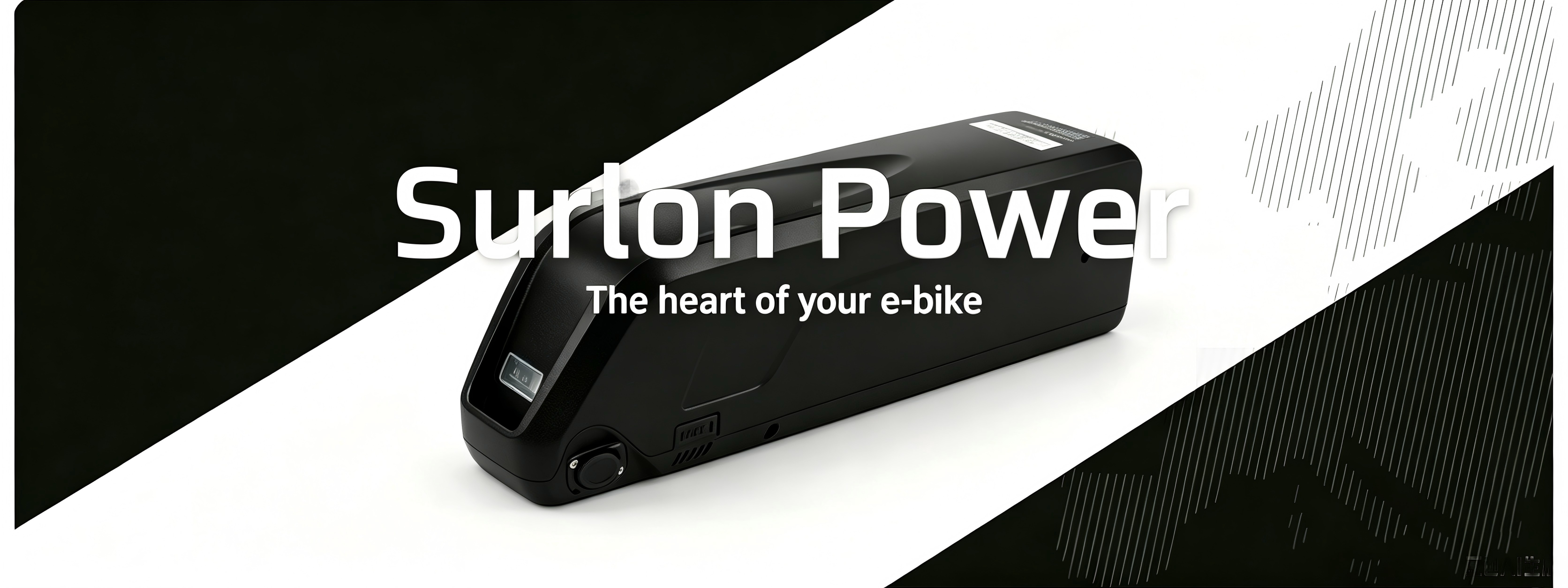
The case protects the cells from the road; the management board protects them from the way the bike is ridden. A 30 A battery management system sits inside the case and watches the pack continuously: it cuts the output on deep discharge, stops the charge on over-voltage, opens the circuit on a short and shuts the pack down if the cells run hot. Between those events it balances the cell groups so that the weakest group does not set the limit for the whole pack.
Balancing matters more than it sounds. In an e-bike pack one drifting cell group quietly reduces the usable capacity of the entire battery, and the rider experiences it as range that fades over a season. Keeping the groups level is what lets the pack hold its usable energy instead of losing a slice of it every few months.
The continuous rating is the figure to design around. This build is rated for 40 A continuous discharge, with a higher short-duration maximum available for acceleration and climbs. If your controller asks for more than the continuous figure for long bursts, say so when you enquire — the management board and the cell configuration are chosen together, and a different current class is a different build, not a setting.
Thermal behaviour follows the same logic. The cells sit in a rigid holder inside the case rather than loose, and the board is mounted away from the hottest part of the pack. On a long climb the housing absorbs short peaks and the management board steps in only when a real limit is reached.


On a full charge this pack is quoted at up to 130 km with the motor in eco and up to 60 km in turbo. The two numbers describe the same battery under two very different loads, and the gap between them is the honest part of the claim: assist level, not battery quality, decides most of the distance.
The eco figure assumes the motor is adding a modest share of the effort on a route with few stops, a rider of average weight, mild weather and correctly inflated tyres. The turbo figure assumes the motor is doing most of the work — the way a rider uses a bike on a hilly commute or when they are running late. Between the two there is a wide band, and most riders land somewhere in the middle of it.
Other things move the number as much as the assist level: a loaded cargo bike, a route with constant traffic-light starts, a cold morning, a soft tyre or a dragging brake. Two identical packs can return 70 km and 100 km on the same day for that reason.
For fleet planning, take the lower figure as your working assumption and the higher one as the upper bound. An operator who plans around 60 km will rarely be caught out; one who plans around 130 km will be charging mid-shift.
If you need a defensible number for a tender or for your own product literature, run the route you actually sell against, at the assist level your customers actually use, and keep the record. That number will hold up better than any single headline figure, ours included.

| Parameter | Value |
|---|---|
| Product code | 48V25Ah |
| Nominal voltage | 48V |
| Internal resistance | ≦120mΩ |
| Combination method | 13S5P |
| Weight | 6Kg |
| Charging limit voltage | 54.6V |
| Standard charging current | 2A |
| Maximum charging current | 5A |
| Discharge cut-off voltage | 35.75V |
| Standard discharge current | 3.92A |
| Maximum discharge current | 50A |
| Case dimensions (L × W × H) | 96 × 160 × 392 mm |
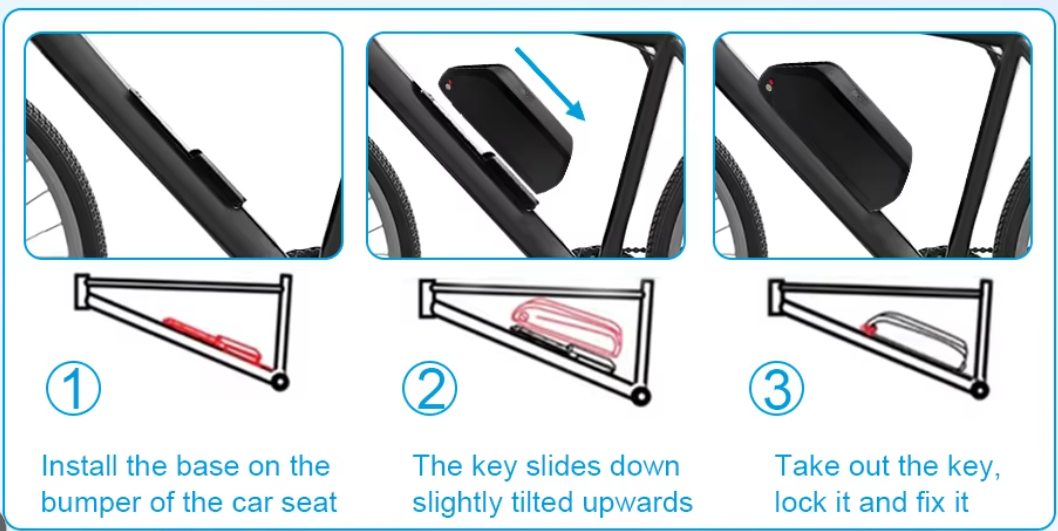


Not every frame takes a stock pack. When a bike has an unusual down tube, a controller with a different current demand, or a battery compartment designed around another case, we build the pack to the drawing instead of asking the frame to change.
Voltage, capacity and cell configuration are the usual starting points: a different series count, a different parallel count, or a different chemistry for a model that needs LiFePO4 rather than NCM. From there the conversation moves to connectors, cable length, the management board's current class and the position of the charging socket — the details that decide whether a pack is easy to install or a permanent source of friction in the workshop.
The process is the same one used for this pack: you send the frame drawing, the controller specification, the charger details and the target runtime; we come back with a proposed configuration and a drawing; a sample is built and run on the actual bike before a batch is agreed. Nothing about a custom build is settled until the sample has been validated on your equipment.
Labels and branding can be discussed as part of the same project. If the pack is going into a bike that carries your own brand, that conversation belongs at the drawing stage rather than at the packing stage.


Inside a durable, sealed housing, we have enclosed not only high-quality cells built for a long lifespan, but also an integrated battery management system that constantly monitors the battery’s operating parameters. It provides the protections that keep every ride safe, including protection against deep discharge, overcharging and overheating, and it balances voltage between cells to extend battery life. The built-in 30A BMS delivers a high-output source of energy for your bike’s electric motor, so you get maximum performance even on the steepest climbs — use 100% of your e-bike’s potential.

Technical questions reach the people who build the packs. Our engineering group in Shenzhen reviews your device's voltage window, load profile, enclosure space and charger before proposing a configuration; our sample group then builds units so you can validate fit and runtime before production. Cell selection, BMS design and pack assembly stay in-house, with quality checks in process and at final inspection, and a documentation team handling certificates, test reports and shipping papers. When a unit behaves unexpectedly in the field, our engineers help trace the fault and advise on installation and commissioning.

Voltage, capacity and cell configuration are the usual starting points, and from there we work through connectors, cable length, management-board current class and the position of the charging socket. Labels and branding can be discussed as part of the same project. As a custom e-bike battery manufacturer we work from your frame drawing and controller specification rather than from a fixed list, and the proposed build is confirmed with a drawing before anything is made.
The board caps the current the bike can draw to what the cells are built for, cuts the output before the cells are drained too far, stops charging if a cell group runs high and opens the circuit on a short. Because the board and the cells are chosen together, those thresholds match this build rather than a generic 48 V pack. For a fleet that means every bike behaves the same way, and a fault can be traced instead of guessed at.
That is what the larger builds are for. Distance per charge is driven by how much energy the pack carries and how hard the motor is working, so capacity and assist level matter more than anything else on the bike. Tell us the route length, the terrain and the assist level your riders actually use, and we will tell you which capacity to specify — the eco and turbo estimates we quote describe the two ends of that band.
Press the button on the top face of the case and the level lights come on. Check it before a shift rather than during one: the indicator is the quickest way for a workshop or a rental desk to sort a pack that needs charging from one that is ready to go out.
NCM gives more energy for the same weight, which is why this Hailong case uses NCM cells — a pack that has to live on a down tube is judged on weight as much as on capacity. LiFePO4 is the better answer when cycle life and thermal stability matter more than weight and the machine can carry a heavier enclosure; floor scrubbers and golf carts are usually specified that way. Compare two proposed packs at the same voltage, weight limit and load rather than choosing on chemistry alone.
The cells sit in a hard-shell case, the charging socket is covered by a rubber cap and the case closes with a key lock, so normal road spray and a wet ride are within what the housing is built for. We do not quote an IP rating for this particular model — if the bike is washed with a hose or used in persistent rain, say so when you contact us and we will advise on the right configuration rather than leave you to assume.
No. The controller, motor and charger all have to belong to the same voltage class, and a 48 V pack on a 36 V system is a mismatch that no wiring change fixes. If your platform is built around 36 V, ask us about the 36V Hailong NCM battery pack instead — the case and the fitting follow the same idea, and the pack is specified around that voltage.


